Showing posts with label Bhutanese. Show all posts

United Daishan Festival

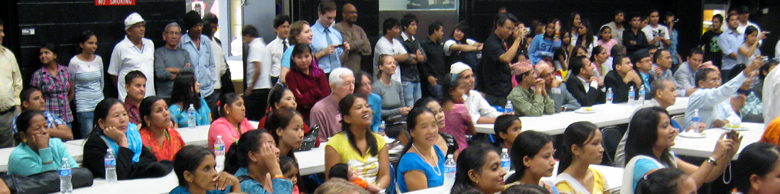
FIRST TIME JOINT EFFORT by immigrant and refugee communities in the Triad to celebrate the most important holiday of the year. OUR DIRECT GOAL: Demonstrate the benefits of group cooperation. OUR INDIRECT GOAL:  Resolve conflict among members of Nepalese and Bhutanese communities. Lay the ground work for future collaborations. Build trust. OUR METHOD: Engage peoples’ minds but reinforce their senses. Over 500 participate, plan, cook, dance, sing, play, compete, talk, eat, drink  and celebrate.
GO TO OFFICIAL SITE FOR PHOTOS, HISTORY  AND DOCUMENTATION:  http://uniteddashain.blogspot.com/
COVERAGE
Locally Grown
FaithAction E-News
––––––––––––––––––––––––––––––––––––––––––––
COUNTDOWN TO UNITED DASHAIN SOCCER CUP
OCT 8, 2011 United Dashain Tournament
On Saturday, October 8 international soccer teams will engage in friendly competition in the spirit of community unity at Greensboro city soccer field at Naco Road (near the Armory). Starts at 10 AM.

8:00 pm, Oct 8: Moon rises, car stereo begins to boom, players from all teams hang out. The tournament is over!
7:30 pm, Oct 8: Closing ceremony and discussion about sports and community.
12:30 pm, Oct 8:  Food run. MacDonald's offers a big discount.
12:00 noon, Oct 8: High Point Division B arrives
11:00 am, Oct 8: Charlotte team arrives.
10:00 am, Oct 8: Teams arrive. Players put on their team shirts.
Oct 7:Meeting and final revisions
Oct 6: Division A (High Point) can't come; big wedding already scheduled
11:00am, Tuesday, Sept 27: Newsletter copy submitted to FaithAction
4:00 pm, Sunday, Sept 25: Distribution of soccer jerseys to coaches.
–––––––––––––––––––––––––––––––––––––––––––– 
COUNTDOWN TO UNITED DASHAIN FESTIVAL
SEPT 25, 2011 United Dashain Festival
On Sunday, September 25, Dashain traditional food, music and dance  will be open to everyone at Greensboro's Caldcleugh Multicultural Arts Center from 12 noon to 8 PM.
12-8:00 pm, Sunday, Sept 25: First United Dashain event with about 400 in attendance and strong representation of leaders from both communities.
9:00 am Saturday, Sept 24: Hand out Dashain flyers at the GSO Farmer's Curb Market 
4:00 pm, Friday, Sept 23: grant-writing team meeting
2:00 pm, Friday, Sept 23: Pick up printed soccer jerseys
1:00 pm, Friday, Sept 23: Reschedule soccer to Oct 8
11:00 am, Friday, Sept 23: City cancels field reservation due to wet weather
8:00 pm Thursday, Sept 22: Program meeting
9:00 pm Wednesday, Sept 21: Official TNCC support for United Dashain Festival
2:00 pm Wednesday, Sept 21: Organizational details from FaithAction
9:00 pm, Tuesday, Sept 20: Triad Nepalese Community Center board of directors supports United Dashian 
6:00 pm, Tuesday Sept 20: Sound system obtained, soccer schedule finalized, Sunday program notes discussed, goat pictures reviewed
4:00 pm, Tuesday Sept 20: Meeting with David Fraccaro, ED of FaithAction
4:00 pm, Monday, Sept 19: Budget transparency; budget and expenses publicly posted for Nepalese and Bhutanese communities to see
3:00 pm, Monday, Sept 19: Soccer balls and flags purchased at Omega, a local sports store
2:00 pm, Monday, Sept 19: Team jersey order sent in to Zoom, a local printer
5:30 pm, Saturday, Sept 17: Soccer jersey design finalized
11:00 am, Saturday, Sept 17: Bought goat, $180. Looking for second purchase
10:00 am, Saturday, Sept 17: Soccer and event designs up for review
7:00 pm Friday, Sept 16: Soccer practice 
6:30 pm, Friday, Sept 16: Soccer, Culture, and Ambassador meeting at Hunter Glen 
3:30 pm, Friday, Sept 16: Cooking preparations planned 
2:00 pm, Friday, Sept 16: Greensboro soccer field inspection 
9:00 am, Friday, Sept 16: Community Foundation releases funds for United Dashain to FaithAction International House, the fiscal sponsor for United Dashian. 
1:00 pm, Thursday, Sept 15: High Point soccer location changed to Greensboro
7:00 pm, Wednesday, Sept 14: Council of Cultures meeting
11:00 pm, Tuesday, Sept 13: United Dashain Festival Web site goes live 
9:00 am, Tuesday, Sept 13: Community Foundation approves United Dashain budget
4:00 pm, Monday, Sept 12: Bus trip to opening of Bhutanese refugee camp photography exhibit at Kenan Institute of Ethics
Sunday, Sept 11: Creation of standing committees for Dashain; explanation of potluck concept to community members
Saturday, Sept 10: Review of new budget before submission; food responsibilities; games costs
Friday, Sept 9: Tentative reschedule to Sept 24 and 25.
Thursday, Sept 8: A change of plans; Can we organize Dashain a week earlier than originally planned?
–––––––––––––––––––––––––––––––––––––––––––– 
CONFLICT RESOLUTION: ORIGINAL DASHAIN PROPOSAL

September: Can this project still go through?
Late Summer: Approval to modify conflict resolution strategy and narrative.
Late Summer: Discussions with TNCC about grant implementation
Summer: Grant approval by Community Foundation
Mar, 2001: Triad Nepalese Community Center organization meeting and celebration of Holi.
Feb 11, 2011: Submission of grant to Community Foundation of Greater Greensboro
Feb 3+ 2011: Meetings to discuss budget details
Feb 2, 2011: Meeting with proposed facilitators to discuss process of conflict resolution, details of bringing parties together, history and roots of communities' conflicts.
Jan 2011: Drafts of grant narrative
Jan 2011: Discussions about applying for a grant to address conflict resolution in Nepalese and Bhutanse communities.

Conflict Resolution, Community Building Between Nepalese & Bhutanese

Multiculturalism at work.   Chef Jeff Bacon, executive director of the Triad Community Kitchen, collaborates with Roshan Shrestra, a GTCC culinary student, and Hari, a Nepali refugee, to create a new Nepali-American recipe as they prepare for DATS  MashUp. During this event refugee women got the opportunity to work in a professional kitchen and learn employable skills.

IN THE GUILFORD COUNTY (NC) area, there are about 300 Nepalese immigrants and 500 Bhutanese refugees, with the latter population continuing to grow as resettlement continues. The Triad Nepalese Community Center (TNCC) was formed in March, 2010 to initiate more community dialogue and discussion about common issues and problems. Bhutanese associate themselves with Nepalese culture. Before they came to the US, they had moved from Nepal to Bhutan about 100 years ago. As refugees, their experience and history is significantly different from Nepali Americans, yet both share a common heritage.

Working with TNCC, we have developed proposals for conflict resolution meetings between the two groups as they seek to create common ground.

A strong, united community will be able to best represent the interests of its members beyond the brief time that refugees are under the supervision of local resettlement agencies.

Preserving culture, preserving identity.  Members of the Triad Nepalese Community Center and Betsy Renfrew, grant facilitator, work with Bhutanese refugees to preserve and promote textile crafts. Although most American stakeholders in the region support the idea of refugees preserving their cultural values, it conflicts with their hurried goal to get them jobs and teach them English. As artists, we lament the lack of serious dialog about this important matter. Increasingly, as dollars become more scarce, local acculturation efforts seem to resemble nothing more than rushed Americanization. If refugees can organize and begin making their own community decisions, they're more likely to be able to hold their own against the prevailing interests of American agencies.
_________________________________________ 

Update: October 2011
United Dashain Festival was organized by the Nepalese and Bhutanese communities working together.  The communities dealt with their internal differences and confronted hard-to-solve problems. Significant achievements were made, such as attendance by over 500 community members, active participation in planning committees, and a soccer tournament that featured rough but fair play.

We played the role of technical advisors, assisting with grant-writing (to the Community Foundation of Greater Greensboro, which approved a $2500 grant), community relations, and documentation.

Bhutanese Learning English While Training in a Community Kitchen

LEARNING ENGLISH THROUGH CULTURAL VALUES AND REFUGEE STRENGTHS
The women got out of cramped apartments and did something familiar from their old lives (Mental Health). They engaged in employment-related skill building (Job Training). They engaged in true acculturation, teaching their Nepali language and traditions and learning American words and customs. They practiced English. They socialized with Americans. They felt confident and asked to continue training (Empowerment). They learned by doing and retained more information (Kinesthetic Learning).

THIS PHOTO DOCUMENTATION records Bhutanese women who took part in DATS MashUp, an event I organized that matched refugees and professional chefs in a collaborative cooking experience. Their challenge was to overcome language and communication obstacles and create recipes that combined the knowledge of both. Finally, they would present their results to a live audience.

This documentation shows how refugees who struggle with English quickly overcome communication problems when they have an opportunity to share something of value from their culture (Nepali food), learn something of compelling interest to them (American cooking practice, work in a professional kitchen, related job training, opportunities to travel to a new city, chances to practice English), have the ability to express their knowledge through words and actions (kinesthetic experiences — “learning by doing”), and see their knowledge and experience respected and validated by Americans (through the formal presentation at DATS which included samplings by Americans of their recipes).

These photos can be used by a teacher in the traditional classroom as follow-up, review and reinforcement. At the end of this page are photos of kitchen implements and equipment the women used. These photos can be used by the women to create a PhotoVoice learning and empowering document. They can form the basis of a training manual for developing job skills in the Nepali population.

FIRST DAY: MEETING AND SHARING


Through Narayan Khadka and Dian Nussbaum we met Nepali women interested in participating in a cooking collaborative. Women were asked to bring ingredients and foods they liked to cook with. This started a lively round of conversation. We learned something about traditional Nepali cooking and the names of ingredients.
________________

SETTING A COMMON GOAL


Roshan is a Nepali immigrant and US citizen who has worked as a professional cook throughout the world. He is sympathetic to the refugees and respectful to the women, some of whom arrived only months ago. He explains the high standards he expects and the opportunity the collaboration project represents. Most importantly, he explains the goal they all must agree to work towards. In the end, of the four women in the room, two drop out and the next day, a new member joins.
________________

SECOND DAY: WORK


Here the team arrives at the Second Harvest Food Bank located in Winston-Salem. I explained to the team the exact time at which I'd arrive to pick them up and drive them from their apartment complex in Greensboro so we could make our 11:00 am meeting.  Because we want to emphasize cultural values first and foremost, we respect the cup of morning coffee offered us, the lengthy neighborly conversation that goes on before we all get into the car, and other trust-building activities inherent in our approach to cultural learning and sharing.
________________

SANITATION


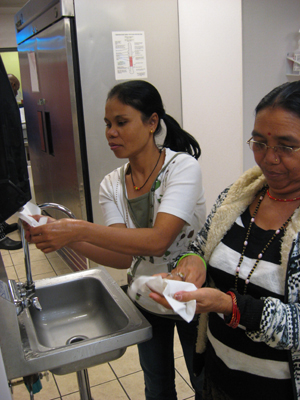
The women met Chef Pam who would assist Roshan. They knew they would work with a purple sweet potato as stipulated by collaboration rules. Although they had not cooked with the purple sweet potato, they were familiar with the native Nepali cultivar which had white flesh. They learn about hygiene and cleanliness in the kitchen. They learn the English apron and tie and tie in the front and tie in the back.
________________

PEELING


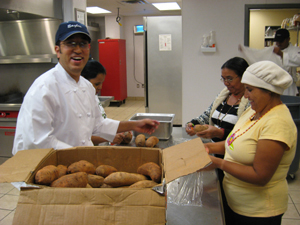
Roshan shows by example. Notice the communal activity. The peelers take some getting used to and the women eventually master the technique of keeping the blade flat on the potato surface and using single, sweeping gestures. When a potato falls to the floor a woman is corrected and told to throw it away. When another's hands touch the floor, she is told she must wash her hands. Most of these activities are familiar to the women, mothers all, who certainly know how to prep and cook. But the context is different, challenging and engaging. This exercise introduces English words such as peel and skin.
________________

CUTTING


Here the women are shown how to cut the purple sweet potatoes. Chef Jeff Bacon also converses with the women and Chef Harry also lends a hand. Some practice professional cutting technique after observing the chefs' own work. The other chefs help set up the womens' work stations and do clean up. Later, some of the women help in the clean up tasks.
________________

PICK AND MINCE


Here the women are given the task of picking cilantro leaves from the stem and then mincing or finely cutting the leaves. Exercises like these lend themselves to talk such as the Nepali word for cilantro, the distinction made between cilantro and coriander, and how the individual women use it.
________________

CHOPPING NUTS


Here Roshan demonstrates how walnuts are chopped.
________________

CURRY


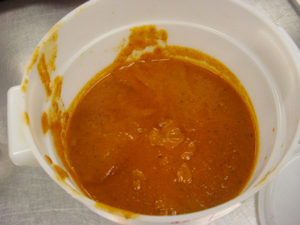
Here Roshan has prepped a traditional Nepali curry all the women recognize but then adds the purple sweet potato. During the course of this prep the women observed the ingredients and spoke about their Nepali names.
________________

DOUGH


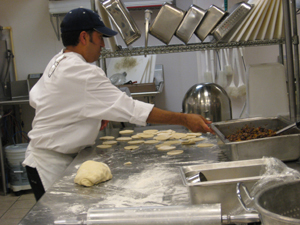
Here the women observe the discussion between Chef Jeff and Roshan about the preparation of singara (or sumosa) wrappers. They discuss the dough consistency. Chef Jeff offers to roll and cut the wrappers or to hand-form them, the traditional way. The two agree on the faster roll method, which the women observe.
________________

SINGARA


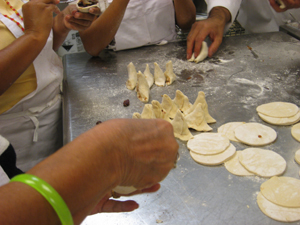
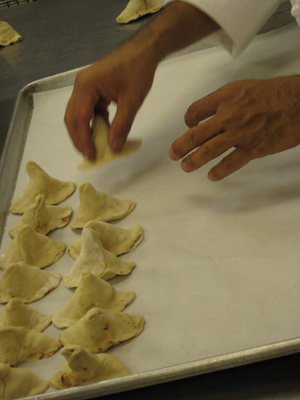
Although making singara, or sumosa, is familiar to the women, Roshan shows them particular details, such as closing the dough so it does not come open during frying.
________________

COOK


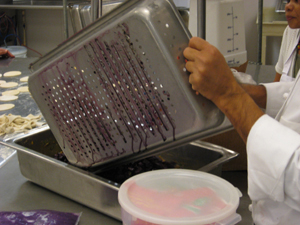
Here Roshan prepares an un-Nepali-like dish, cooking sweet potatoes, adding butter, sugar, milk, nuts, nutmeg, and other spices, some new to the women. Later he pours it into cooling trays...
 ________________

PUDDING


...And at the day's end the women see their peeled sweet potatoes have become sweet potato pudding samples, ready for presentation on Saturday's public event.
 ________________

THIRD DAY: FRYING


The team returned two days later, the day of the public event, to fry the singara. After testing by Roshan, each woman takes a turn using the professional fryer.
________________

PLATE


Here the women watch Roshan create presentation plates.
________________

PUBLIC PRESENTATION


Finally,  the women arrive at 1 pm at the Sawtooth. There they meet the other teams, speak with reporters, and afterward, speak with members of the audience who have tasted their samples. Through the cooking collaboration we created a powerful learning opportunity for the Nepali women that offered multiple, reinforcing experiences to use English, interact with English speakers, and to share meaningful exchanges. The American audience was delighted to meet them and the public setting gave them the chance to converse with refugees, something that rarely happens in daily life or in chance encounters on the street.

Cultural and linguistic isolation is probably the main reason for refugees' poor English, even after years of being here and attending ESOL classes. Narayan reported that the women enjoyed this experience and wanted to know if they could return to the Triad Community Kitchen to continue learning.
________________

VOCABULARY REVIEW