Showing posts with label design for preliterate audience. Show all posts

Getting Moms into Doctors' Offices (1)

FOUR RECENT CASES SHOW WHY INDIGENT HEALTH CARE IS HARD TO OBTAIN FOR MONTAGNARD REFUGEES AND HOW COMMUNITY HEALTH WORKERS ARE AN AFFORDABLE SOLUTION FOR TIME-INTENSIVE OUTREACH AND FOLLOW UP
SEE PART 2


WORKING WITH MONTAGNARD LAY community health workers, we identified 13 steps to get refugee moms indigent healthcare (the "Orange Card" issued by the Guilford Community Care Network) so they can see a doctor. In Montagnard families, working dads are sometimes covered by employers and children qualify for Medicaid, leaving moms the most vulnerable member. Without health coverage they suffer from illnesses and chronic problems. 

Every step presents opportunities for failure. Our lay health workers operate within the cultural constraints of their community. We don't have a steady framework of grants or funding sources to adequately pay them but their liaison skills are critical; they speak all the languages needed to contact families. They are familiar with the qualifying process and can explain it. But the most needy Montagnard families are often preliterate. Financial papers, receipts and junk mail are mixed together. Records are lost or missing.

Recently, we worked with four Montagnard families to get Orange Cards. Our lay health workers — mothers themselves — identified neighbors who hadn't been to a doctor in years. One is in regular pain. Each speaks a different language. Three are preliterate; they do not read their native language. Their English skill is poor. All receive food stamps. If they can find childcare or bus fare, they attend ESOL classes. But in general, the services they receive from local agencies are disconnected and sporadic. It is only through contacts with our lay health workers that we know their plight. We spent the week prepping the women to get their papers together. One got the card, one might get it next week, and two are in limbo.
The first mom is middle aged. Her husband worked but made poverty level (minimum) wages, easily qualifying her for the Orange Card. At the qualifying interview she failed to bring bank statements even though we explained their necessity. The family made it a regular habit to throw them away and because only her husband's name appeared on the statement, we couldn't go to the bank and get copies.

The second mom came from a very troubled home. She looks like she's sixty but her ID states she's in her early 50s. She has several grown kids back in Vietnam and lots of grandchildren there, too. Several months ago we tried to get her an Orange Card and failed. Then we tried again at a health fair. Her paper work was good and her son accompanied her to verify his wages. But she never got her card. By our third try her family's circumstances had changed.  Her husband was out of jail but unemployed. The son was no longer being paid under the table by his employer. He had check stubs — proof of income — but now he was working out of state. He'd be back in another week, maybe. In the meantime, our second mom suffers from chronic pain.

The third mom is from a young family. The husband works sporadically and is now out of town. We'd like to get him to verify his wages (again, they're poverty level). The husband doesn't have a great reputation but we're trying to help his wife, not him. If we can get records of his recent wages she can get an Orange Card. We have asked a community leader for additional assistance. 

The fourth mom is middle aged. Her husband is elderly but works part time. She is well liked by people in her community and has rudimentary writing skills. She has all her paper work in order and receives her Orange Card. Our lay health workers will follow up and schedule her first doctor's appointment at Healthserve with a call next week.

Orange Card For Refugee Moms

Refugee and Diversity > Health > Orange Card for Refugee Moms
The Orange Card is a pre-approved, sliding scale health care program for those without coverage.
PDF color download
Awareness
Costs are low and almost all Montagnard families qualify because of their low income and numbers of people in the household. But while some families might have good insurance through the father's employer that includes the kids, often the mother is left without coverage. This design points out the economic choices a family makes and informs members that mom's visits to the doctor are affordable compared to other costs, especially those detrimental to good health.

Forgetting or not understanding which documents to bring
Successful enrollment requires several documents and proof of need, but too many fail to bring the correct papers. The handout shown below is designed for easy reading and as a visual reminder for those who cannot read or read with difficulty.

Driving home the message
We plan to have the lay health team use the handout to explain to moms and family members so when they come to sign-up sessions, they'll be quickly enrolled. We can introduce this at the end of food insecurity interviews and use it in ESOL classes. Through this coordinated approach, we hope to improve enrollment numbers and get eligible community members covered.

PDF color download
PDF bw download


Design and American Assumptions in Refugee Education

(Refugee and Diversity Projects) > Health > Design and Assumptions


Am I fat? is the starting point for health education and good outcomes


American information designed for a general audience is adopted haphazardly for refugees.

For unique populations such as the Montagnards, who speak as many as 6-8 languages but are often preliterate (unable to read or write), such a design approach with its underlying assumptions often fails, even if it succeeds with other, more literate or empowered ethic groups.

Design is inherently connected to culture. The more Americans forget this, the more likely their designs will fail to communicate. In the example given below there are likely to be additional negative consequences such as resentment and frustration on top of failure to follow doctors’ recommendations. Here is a follow up form for  blood glucose screening (testing for high blood sugar, a sign of diabetes):


Here the client is told to make an appointment to see a doctor, a typical recommendation. But if she is poor and without insurance (likely) then what is the chance of follow through? She may defer to the doctor or clinician and not ask questions. If she is with an interpreter friend, the friend may not wish to offend the health professional or admit their inability to pay. The design flaw here is that it does not anticipate these reactions and offers no options.


In this example, the client is asked to reduce risk by changing lifestyle. The majority of Montagnards were farmers used to hard, long days in the field. When they come to America they rarely engage in equally physically demanding work and lead sedentary lives holed up in small apartments. A farmer measures her physical labor differently than the American office worker on the treadmill during her lunch break. Unless she is shown how to jog or do a workout, a refugee will probably not understand exactly what “regular exercise” actually entails for a modern urban dweller.


Click to enlarge

The above flowchart starts with the question, Am I fat? because this was how the women of the Montagnard lay health team approached the problem of diseases associated with diet and lifestyle choices. We followed their question with a talk about BMI and how to look it up on a color-coded chart.

Once we established an objective baseline for weight, we then went on to discuss how could someone of normal weight still have significant health problems, a puzzling question to them because while they knew of many sick community members, few were overweight or obese. 

The chart then asks about diet, whether one has a poor diet or one of balanced meals, terms also used in a food insecurity interview they have been helping with. Finally, the chart identifies foods used in Montagnard cooking as possible high sodium culprits and links them to certain diseases like diabetes.


Through this chart we sought to link a simple question, Am I fat? to weight, food choices, lifestyle and disease. We approached it from the Montagnards’ viewpoint, taking into consideration their knowledge and understanding of the problem as they experience it through the illnesses of their family members, friends and neighbors.

It is possible to effectively communicate with a preliterate, multilingual community and obtain positive outcomes, but only if American designers are willing to incorporate Montagnard views and cultural ideas. Mere translation of existing English language or text is grossly inadequate. One experienced refugee worker insisted that rules (in effect, design guidelines) should be established for all refugee groups (one shoe fits all). Such a policy is certainly convenient for her office and reduces the workload for her staff. But it's unlikely to yield good outcomes.

Visual Guide to Food Amounts

(Refugee and Diversity Projects) > Health > Visual Guide: Food Amounts

Most women don't refer to cookbooks or measure in cups and tablespoons.

With the lay health workers’ help, I developed this visual guide.

Click to enlarge.

Montagnard Translation Issues

A 2010 SUMMARY OF THE PROBLEM. SINCE THEN TECHNOLOGY CONTINUES TO LOWER COSTS — SMART PHONES HAVE REPLACED IPODS — WHILE THE LIKELY IMPACT ON SERIOUS MEDICAL CONSEQUENCES AND INFRINGEMENTS ON LEGAL AND CIVIL RIGHTS GROWS.


This is a brief, non-scholarly overview of the technical issues connected with the translation of practical information (health, education, consumer) for the Montagnard American population. As the reader will note, there are several specific issues that make translation both a challenge and an interesting technical opportunity. I’ve worked with educated, well-respected Montagnards on the translation of Census 2010 forms and audio and video-format delivery, health info, and US citizenship study questions. 

                I.   Snapshot Overview of the Problem and Bottom Line Recommendations
                II.  Cultural Factors Influencing Translation (items a-g)
                III. General Guidelines (items 1-10)
                IV.  Specs and Costs

I.  Snapshot of the Problem
The Montagnard (or Dega, Degar) population located in North Carolina’s Piedmont is the largest concentration of Central Highland peoples outside of Southeast Asia. Greensboro and Guilford County probably have the largest number, perhaps 10,000. Unfortunately their numbers are not overwhelming such that translated materials available to Spanish and Vietnamese speakers are also available to Montagnards. Here they are merely enough to chronically burden schools, hospitals, and other agencies with the periodic (but expensive) cost of providing translators and interpreters.

Despite their small numbers relative to North Carolina and the US, their local numbers are concentrated and significant. Over such a long time (since 1986), one wonders why no steps have been taken by authorities to resolve the translation problem. The lack of very basic information for the community has certainly contributed to many difficulties individual Montagnards have experienced, such as health, diet, housing, and education. The 2010 Census will reveal more accurate numbers, perhaps causing the community to demand more translation and other services. But by and large the population is apolitical about their rights and responsibilities in the US and it has no advocates in local or state politics. 

Bottom Line Recommendations:
When scarce dollars are spent on Montagnard translations, they should be accurate. There appear to be no standards for Montagnard translation. For example, one flyer translated into Rhade omitted all diacriticals (accent marks). Another example I saw included glaring spelling errors according to two educated Montagnards I consulted.
Translations should be effective, otherwise why bother? Since many Montagnards can't read their spoken language, audio and video media will be far more effective than text.
• Put the costs of translation and audio and video production into the budget. Without doing this, a project's reach and impact will be severely limited. Often translation costs are a last-minute inclusion. For the Montagnard population, communication is the number one problem. Calculate communication costs early on.
• Get your money's worth. I've seen a few US pamphlets, brochures, or information sheets appear in any of their five languages. Most are one-off publications, meaning that no attempt was made to create a series of publications or an ongoing venture that could reduce costs.
____________________________

Based on my work with the Montagnard community over the past two years, I've found several cultural factors that influence the nature and form of translation work for this population. The following addresses specific language issues.

II.  Cultural Factors Influencing Translation

a) Some but not all speak Vietnamese.
Nonetheless, this seems to have inspired Americans to provide Vietnamese-translated literature as a solution. They often don't realize or don't wish to acknowledge that Vietnamese is not Montagnards' primary language and may be only partially understood. So although many Montagnards might understand or appear to speak basic Vietnamese, their level of fluency, reading ability and comprehension is directly related to their association with Vietnamese speakers or education they received in Vietnam. So a cautionary note: Few Montagnards have completed high school. Most appear to have less than six years of formal schooling. Some have had only one or two years, or none.

There would appear to be potentially serious consequences associated with American’ reliance on Vietnamese translations to inform Montagnards about say, drug prescriptions or health-related matters.

b) Some Montagnards can speak and understand Vietnamese but object to receiving Vietnamese-based information for cultural, historical or political reasons.
Presumably, such views should be respected. All Montagnards see themselves as culturally distinct from ethnic Vietnamese. Some fought for the US during the Vietnam War, organized into distinct units. The ethnic and linguistic history of the Montagnards clearly supports their position.

A Census brochure I created in Rhade, Bunong, Koho, Jarai and English. It was distributed to pastors and other Montagnard leaders as part of MDA’s initiative to push the counting of the population in 2010, a first for the Montagnard community.

c) Montagnard culture consists of at least 5 major language groups: Jarai, Rhade, Koho, Bahnar, and Bunong.  Point of clarification: There is no language called “Montagnard”. Some, such as Rhade, are close enough to be understood by Jarai speakers but there is no single language that could serve as a universally intelligible language. In fact, there are many dialects (Cil, Ma, Chru) and more languages (Sedang) which exist in the current population than just the five main groups.

d) Many Montagnards are preliterate, meaning they received only a few years of education and cannot read their own spoken language.

This is certainly not true for all Montagnards, the oldest of which often were formally schooled and received advanced training, but it does suggest the importance of audio and video messages over written texts.

e) Older Montagnards (45+) generally know many Montagnard languages, Vietnamese and may even know Thai, Cambodian, Laotian. Rarely, they will know French and even some Chinese. Younger adults tend to know their primary language and some Vietnamese. Those born in Vietnam but raised here may only know English and their parents' primary language. This is certainly true for those Montagnard Americans born in the US.

Most adults value their language as an expression of their identity and culture, even if they write it poorly or haltingly. Those with the strongest language skills and most able to produce authoritative translations are rapidly aging. Translation work should be done now, while the most able and skilled are interested and active.

f) There are certain technical or other terms for which there are no equivalents in Montagnard languages. Translators seek good compromises with explanatory text as needed. It appears that the best translations tend to be wordy; the translator prefers to indulge in lengthy explanation rather than risk brevity and misunderstanding.

g) Most Montagnards are multilingual when most Americans are monolingual. English is a difficult language to learn for almost everyone who wasn't introduced to it when they were young, so the slowness they have in picking up the language has more to do with cultural isolation than inherent skill. Increasing the amount of translated material available to them should be considered part of a larger effort to break cultural and linguistic isolation.


____________________________

The following seeks to establish some guidelines for policy makers, officials, project managers, grant writers, etc. Because I advocate for audio and video production in addition to standard translation, I've expanded on these points, including some info on costs.

III. General Guidelines
1. In the 2010 Census, the Montagnard community agreed to check "Other Asian" and write in "Montagnard" to ethnically identify themselves. Leaders agreed they consider themselves first and foremost Montagnards, and only afterward by their tribal and language identity (Koho, Jarai, etc). So whether they ever invoke Title 6 of the 1964 Civil Rights Act to obtain more translation services, it seems Montagnard Americans will have successfully established an official identity in the greater American population.
     This would seem to have looming implications for American authorities.

2. American authorities and agencies must
     A) Commit to qualitative standards when translating Montagnard languages. This includes inclusion of diacriticals (accent marks). 
     B) Include translation and media production costs into grants, projects and undertakings involving the Montagnard community if they wish to effectively communicate. Live translation is expensive and requires advanced scheduling. Audio and video messaging can help deliver important information. Text-based information is least effective.

3. Vietnamese should not be offered as a substitute for the Montagnard languages to Montagnards by American authorities  (anymore than they should be offered Spanish, Russian, or German!).

4. Ideally, a Montagnard Koho should be provided with Koho-translated information. Reasonable, sincere efforts should be made to provide this and the other four languages.

Most Montagnards agree that Rhade will be reliably understood by Jarai speakers. Some Rhade speakers refer to Rhade as the “Montagnard language", but it's clear that not all Montagnards understand it. We need more discussion and feedback if we want to prioritize language translations. There is no reliable data on language breakdowns in the Montagnard American population to guide us.

5. Expanded definition of “translation”. Making translated information available to Montagnards means the availability of
     • written text translation,
     • audio translation, and
     • depending on the content, video presentation.

Only making text information available is bound to be insufficient and ineffective, as history has proven.

6. Written text. Although many users do not read, written text is the definitive data source on which we base audio and video versions. A text version is valuable for scholarly and comparative purposes, for building a database, and for repurposing information —an important factor in eventually reducing translation and production time and associated costs.

It probably has yet another valuable reason for being: The compilation of enough texts would serve as the raw material for native language classes, something educated Montagnards have attempted in the past. For many, they fear their children will forget their native language. For the Montagnards, many of whom must rely on memory, having written texts would be a way of assuring them that their culture will not be lost over time. If you’re looking for the assistance of the Montagnard leadership to help produce translations, the cultural preservation of language is a powerful influencer.
    
7. Translated audio. Recorded audio messages in translation can overcome the language barrier and is the surest way of clear communication, short of expensive face-to-face delivery by another native speaker.

8. Video format. Information should be produced in video English and translated video where the video medium will enhance the user's understanding. Video costs, like all things digital, have come down tremendously. Consider augmenting audio recordings with video, especially if the listener is learning something new, since the more engaged a learner's senses are, the more likely she'll remember the lesson. And, it doesn't cost much more to create video once text and audio clips are in existence — so might as well do all three formats together.

9. Delivery
     • Text, which can be printed, copied, easily carried and edited, is very cheap but historically inaccessible to most Montagnards, even when the text is in their native language.
     • Audio requires a delivery device. Most Montagnards own cell phones which could be used to deliver translated recordings. AM and FM radio are limited by range and require an FCC license. Podcasting and Web radio require Internet access, which many Montagnards have access to through their children or friends. Internet access through Wi-Fi devices such as netbooks, laptops, and other hand held devices is a relatively inexpensive method for delivery. Downloading audio onto cheap MP3 players and periodically updating them is another.
     • Video delivery is also theoretically possible through cellphones, easier with the latest high-end devices such as iPhones or iPod Touches, via YouTube or Quicktime. Netbooks, laptops, and desktop computers all have video delivery capability but would require Web access with broadband to be worth it.

10. Notes on comparative costs. Live translation costs vary. A three-way telephone translation is usually available in healthcare settings and costs perhaps $1.50 a minute ($90+ an hour). The cost of personal translation and interpretation help in the Montagnard community — what they charge each other — seems to be about $25 an hour for a translator to accompany an individual to a doctor or attorney's office. But community translators aren't always available since no one pursues this full time.

While it can be argued that audio delivery imposes an additional cost to the user, the presumption is that some costs are already offset because the user already owns or has access to a delivery device, or that the user is accustomed to paying a certain amount for personal translation service, or that any added costs would be made up for by superior results, ie, better, money-saving choices made by a better informed consumer.

A good example of how dollars might be better spent would be if Montagnards purchased the iPod Touch instead of the portable English-Vietnamese-Chinese hand-held translation device that sells locally for about $200 (the same as an iPod). With the iPod the user can download a free Vietnamese dictionary as well as access and store audio and video translations. If the user is within free WiFi range, she also has Internet access. The iPod is a relatively cheap but flexible media delivery system. It also has an easy interface for preliterate adults to learn.

___________________________

The following is intended as an outline of work steps for technical translation work and audio and video production with some notes on man-hour costs.
 

IV. Specs and Costs

The key to a sustainable model for translation is to reduce costs and time while maintaining quality. Computerization solves some important production and delivery issues that were not available in the past. The methods I've adopted can certainly stand improvement. I've deliberately kept to readily accessible software and methods which are relatively cheap and not especially technically difficult.

• To see examples of videos, see http://sites.google.com/site/mdagreensboronc/census-2010

• Go to individual language links to see pdf examples.

Text
Handwritten translation. A big problem but not easily avoidable if the expert does not use a computer.


Typewritten translation. Better than handwritten. The translator has added diacriticals by hand. Translators check their spelling and use of accents against Bible translations.


Edited transcription. A younger Montagnard was asked to review and notate the manuscript. Although she was not sure about spelling and use of diacriticals, she made suggestions about phrases that she felt would be more clearly understood.


Work Steps
1) Authoritative English text source, preferably in text (txt, rtf, etc) format
2) Goes to translator for first pass
3) Translator's draft, expect typed or handwritten
4) Draft converted to digital text
5) Diacriticals added
6) Translator proofs digital version
7) Final text approved

Audio
8) Translator reads final text; audio recorded in a program such as Audacity.
9) Audio cleaned and edited

Visuals, graphics


An early design showing Rhade and English translations side by side. Because the type size was small, I decided to go with a full screen image of the original English Census form zoomed to each question, and added the Montagnard text at the bottom of the screen.

10) Visuals (video, graphics) created in image editing program like Photoshop.

Video


11) Text, audio, and visuals imported into video editing software such iMovie.
12) Video edit

Output/delivery
13) Text output in .rtf, .doc, .pdf
14) Audio output in .mp3
15) Video output as .mov for YouTube, iPhone/iPod

A rough breakdown of production time for 1.5 pages looked like this:
Translator: 2 hours of translation
Editor: 2 hours of transcription and editing
Sound: 1 hour of audio
Video: 2 hours of video
Graphics: 1 hour of graphics

To create each version of the Census 2010 text, audio and video required about 8 man hours, or a full day of work, for about 1.5 pages of text.

Reducing costs
Designing and laying out text for a more pleasing printed version, or laying text out in a Web page is time not included in the above. Obviously graphic design and layout can enhance a finished product, but in some instances bare-bones text or minimum design will do. For the Census videos, the same design format and graphic style were used for Jarai, Bunong, Rhade and Koho, reducing costs.

To the lay person this might look like a lot of work, but compared to the pre-digital past when video cost a thousand dollar a minute, this is cheap indeed. Digital media also has the advantage of being easily reused and redelivered on other platforms.

Creating standalone, individual brochures and texts are expensive. Doing bulk work and deliberately designing content to be reused can bring down costs.

Basic tools and equipment:
Laptop
Digital camera
Flip camera
Internet access
YouTube
Quicktime Pro
Audacity
iMovie
iPod Touch
  

Bhutanese Learning English While Training in a Community Kitchen

LEARNING ENGLISH THROUGH CULTURAL VALUES AND REFUGEE STRENGTHS
The women got out of cramped apartments and did something familiar from their old lives (Mental Health). They engaged in employment-related skill building (Job Training). They engaged in true acculturation, teaching their Nepali language and traditions and learning American words and customs. They practiced English. They socialized with Americans. They felt confident and asked to continue training (Empowerment). They learned by doing and retained more information (Kinesthetic Learning).

THIS PHOTO DOCUMENTATION records Bhutanese women who took part in DATS MashUp, an event I organized that matched refugees and professional chefs in a collaborative cooking experience. Their challenge was to overcome language and communication obstacles and create recipes that combined the knowledge of both. Finally, they would present their results to a live audience.

This documentation shows how refugees who struggle with English quickly overcome communication problems when they have an opportunity to share something of value from their culture (Nepali food), learn something of compelling interest to them (American cooking practice, work in a professional kitchen, related job training, opportunities to travel to a new city, chances to practice English), have the ability to express their knowledge through words and actions (kinesthetic experiences — “learning by doing”), and see their knowledge and experience respected and validated by Americans (through the formal presentation at DATS which included samplings by Americans of their recipes).

These photos can be used by a teacher in the traditional classroom as follow-up, review and reinforcement. At the end of this page are photos of kitchen implements and equipment the women used. These photos can be used by the women to create a PhotoVoice learning and empowering document. They can form the basis of a training manual for developing job skills in the Nepali population.

FIRST DAY: MEETING AND SHARING


Through Narayan Khadka and Dian Nussbaum we met Nepali women interested in participating in a cooking collaborative. Women were asked to bring ingredients and foods they liked to cook with. This started a lively round of conversation. We learned something about traditional Nepali cooking and the names of ingredients.
________________

SETTING A COMMON GOAL


Roshan is a Nepali immigrant and US citizen who has worked as a professional cook throughout the world. He is sympathetic to the refugees and respectful to the women, some of whom arrived only months ago. He explains the high standards he expects and the opportunity the collaboration project represents. Most importantly, he explains the goal they all must agree to work towards. In the end, of the four women in the room, two drop out and the next day, a new member joins.
________________

SECOND DAY: WORK


Here the team arrives at the Second Harvest Food Bank located in Winston-Salem. I explained to the team the exact time at which I'd arrive to pick them up and drive them from their apartment complex in Greensboro so we could make our 11:00 am meeting.  Because we want to emphasize cultural values first and foremost, we respect the cup of morning coffee offered us, the lengthy neighborly conversation that goes on before we all get into the car, and other trust-building activities inherent in our approach to cultural learning and sharing.
________________

SANITATION


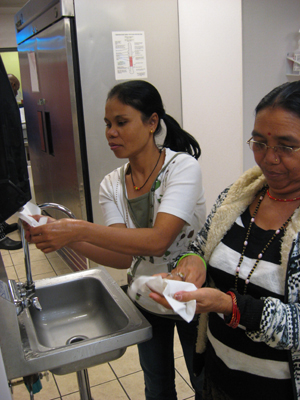
The women met Chef Pam who would assist Roshan. They knew they would work with a purple sweet potato as stipulated by collaboration rules. Although they had not cooked with the purple sweet potato, they were familiar with the native Nepali cultivar which had white flesh. They learn about hygiene and cleanliness in the kitchen. They learn the English apron and tie and tie in the front and tie in the back.
________________

PEELING


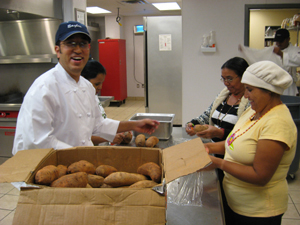
Roshan shows by example. Notice the communal activity. The peelers take some getting used to and the women eventually master the technique of keeping the blade flat on the potato surface and using single, sweeping gestures. When a potato falls to the floor a woman is corrected and told to throw it away. When another's hands touch the floor, she is told she must wash her hands. Most of these activities are familiar to the women, mothers all, who certainly know how to prep and cook. But the context is different, challenging and engaging. This exercise introduces English words such as peel and skin.
________________

CUTTING


Here the women are shown how to cut the purple sweet potatoes. Chef Jeff Bacon also converses with the women and Chef Harry also lends a hand. Some practice professional cutting technique after observing the chefs' own work. The other chefs help set up the womens' work stations and do clean up. Later, some of the women help in the clean up tasks.
________________

PICK AND MINCE


Here the women are given the task of picking cilantro leaves from the stem and then mincing or finely cutting the leaves. Exercises like these lend themselves to talk such as the Nepali word for cilantro, the distinction made between cilantro and coriander, and how the individual women use it.
________________

CHOPPING NUTS


Here Roshan demonstrates how walnuts are chopped.
________________

CURRY


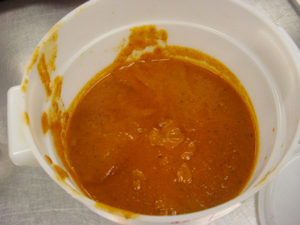
Here Roshan has prepped a traditional Nepali curry all the women recognize but then adds the purple sweet potato. During the course of this prep the women observed the ingredients and spoke about their Nepali names.
________________

DOUGH


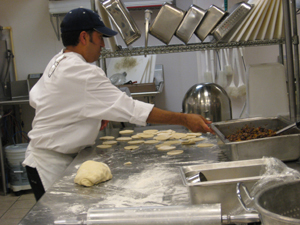
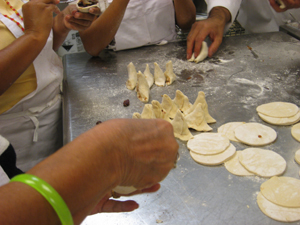
Here the women observe the discussion between Chef Jeff and Roshan about the preparation of singara (or sumosa) wrappers. They discuss the dough consistency. Chef Jeff offers to roll and cut the wrappers or to hand-form them, the traditional way. The two agree on the faster roll method, which the women observe.
________________

SINGARA


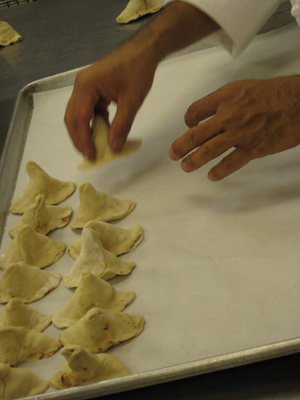
Although making singara, or sumosa, is familiar to the women, Roshan shows them particular details, such as closing the dough so it does not come open during frying.
________________

COOK


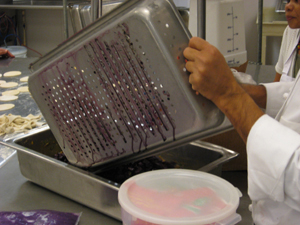
Here Roshan prepares an un-Nepali-like dish, cooking sweet potatoes, adding butter, sugar, milk, nuts, nutmeg, and other spices, some new to the women. Later he pours it into cooling trays...
 ________________

PUDDING


...And at the day's end the women see their peeled sweet potatoes have become sweet potato pudding samples, ready for presentation on Saturday's public event.
 ________________

THIRD DAY: FRYING


The team returned two days later, the day of the public event, to fry the singara. After testing by Roshan, each woman takes a turn using the professional fryer.
________________

PLATE


Here the women watch Roshan create presentation plates.
________________

PUBLIC PRESENTATION


Finally,  the women arrive at 1 pm at the Sawtooth. There they meet the other teams, speak with reporters, and afterward, speak with members of the audience who have tasted their samples. Through the cooking collaboration we created a powerful learning opportunity for the Nepali women that offered multiple, reinforcing experiences to use English, interact with English speakers, and to share meaningful exchanges. The American audience was delighted to meet them and the public setting gave them the chance to converse with refugees, something that rarely happens in daily life or in chance encounters on the street.

Cultural and linguistic isolation is probably the main reason for refugees' poor English, even after years of being here and attending ESOL classes. Narayan reported that the women enjoyed this experience and wanted to know if they could return to the Triad Community Kitchen to continue learning.
________________

VOCABULARY REVIEW