Showing posts with label Montagnard community. Show all posts

Montagnard Citizenship Translation Project

Detail of side by side English-Rhade text (with diacriticals). Notice the line numbers for easier reference and teaching.

A project with the former legal services office of Lutheran Family Services to translate Citizenship test text and produce audio for the Montagnard population, with side-by-side learning English-Rhade text. With the closing of LFS, the material was never widely distributed.

Download text
     • US Citizenship, 100 questions   (cover) (preface) (part 1) (part 2) (part 3)
     • US Citizenship,  20 questions, for elderly   (cover) (preface) (questions) 

Getting Moms into Doctors' Offices (2)

(See Part 1)
THIS ACCOUNT DESCRIBES ONE VISIT TO A TRIAD MONTAGNARD FAMILY BY COMMUNITY HEALTH WORKERS. THE MORE FAMILIES THEY MEET, THE MORE COMPREHENSIVE IS THE PICTURE THAT EMERGES ABOUT SPECIFIC PROBLEMS THE MONTAGNARD COMMUNITY FACES. SPECIFIC PROBLEMS SUGGEST SOLUTIONS THAT CAN SAVE DOCTORS TIME AND MONEY AND RESULT IN BETTER INDIVIDUAL AND COMMUNITY HEALTH.
Traveled: 2.4 miles
Time: 1.5 hours

What we learned: Progress and general well-being of a newly reunified family, status of individuals, sources of income, condition of their home, friends, neighbors and relations. On the way, we made new contacts.

Additional benefits: Since the Community Health Workers (CHWs) also conduct food insecurity research, they built a foundation of trust to return and ask the family about food and nutritional problems. In their Project Shine health literacy mission, they started a conversation with family members about the importance of learning English, especially for the mother.

LAST WEEK WE WERE AT A branch of Sun Trust Bank helping P obtain past bank statements, a requirement for the Orange Card (indigent health care) issued by the Guilford Community Care Network. While we waited, our Montagnard community health worker (CHW) recognized a neighbor and they began to chat. N’s family had been here for a short while. He worked hard, saved thousands, and then spent it to get them here and settled in their new home. He looked slightly tired and a bit worried, but appreciative of our offer to come by his house and see what we could do to help. His English comprehension was rudimentary and communication would not have been possible without the CHW. He said his younger kids had been enrolled into Newcomers School but the oldest boy, in his twenties, needed to learn English and seek a job. We took down his details and promised to visit.

This week we planned to go to N’s apartment to interview the family and see what we could do. We knew he was on second shift so a 10 AM meeting would be convenient. Before going over, we reviewed the family’s information. We knew the location of the apartment complex and other families who lived there. We reviewed the Orange Card application form and decided to test our newest CHW member, a former doctor, and her abilities to complete the form.

We pulled up to the complex. The parking lot was poorly graded with litter on the ground, but this place was not as bad as some apartments which are battered and falling apart. We got a very friendly greeting as the apartment door opened. We pushed off our shoes and entered. Three men were playing cards on the living room floor. Another young man was lying down on a sofa bed watching the card game. One of the card players was holding a baby. Her sister lay snuggled in a child's chair that doubled as a cozy bed.  N’s wife sat above the girl, watching her. Between the living room and the kitchen a portable heater glowed, making the room comfortable. The apartment was sparse but tidy and clean. The TV played “Slumdog Millionaire” with English captions. The volume was set low. We sat down. The three CHWs, all Montagnard women, began to chat and make introductions. As it turned out, N was related to the husband of our former doctor CHW.  This made our conversation very easy.

We were told N was running errands and would soon return. Laughter and jokes and playing with the baby and little girl filled the time.

The oldest needed to find a job but also needed to learn English. We told him Reading Connections taught an ESOL class just a few blocks away, every Saturday. His friend explained he’d like to go to GTCC but he works ten hours a day and is usually too tired to go to night school. This started a general discussion about the importance of learning English. We encouraged the mom to go, too. We repeated the class time and emphasized that class is free. The younger children at Newcomers School don’t have Medicaid coverage. The father didn’t know why.

As the interview continued, the neighbors left. We encouraged the working boy as he said his goodbyes to make the effort to go to English class.

The little girl woke up. She and her sister are the daughters of a D. I hadn’t seen him in over a year, then saw him just recently at a Christmas pageant. 

N arrived. He warmly greeted us and our former doctor CHW. Everyone sat and she started the interview. An Orange Card application usually requires ID, Social Security card, recent bank statements confirming assets, employment check stubs to prove work income, and a recent tax return. We checked their documentation. All of the family had green cards but not North Carolina ID. They didn't have their Social Security cards yet. N’s address on his ID was old and needed replacing. Did he think he could get it updated? Did he know how to get to the DMV? We discussed how much an updated ID costs. He felt sure he can do this on his own. His bank statements were missing. He said he didn’t inform his bank about his new address when he got this apartment for his family. This lead to a discussion about his food stamp application which is two months old. Maybe it was sent to his old address? We’re not sure. We decided we could help him check into this next week. He had his tax return in order and he has recent pay statements from his employer.

Before we left we told N about the proximity of ESOL class and repeated our encouragement to the oldest son and his mom in his presence. In the parking lot the CHWs talked to a young Montagnard couple who were getting in their car.

We then accompanied N to Sun Trust to get bank statement printouts. On the way we dropped off two of our CHWs, then went on to the bank. We made sure the bank clerk understood his request. The clerk updated his address and because his bank card was old, put in an application on his behalf for a new one. We said our goodbyes in the Sun Trust parking lot. The CHWs would follow up next week.

As I turned to my car, I greeted another refugee man I'd been meaning to talk to. We made a lunch date. Another guy pulled up and waved. We got his him an Orange Card last week.

Final note: The original CHW team has managed to stay together despite modest funding that’s been stop and go. As they introduce a third member, a former doctor, to  their work, they stand a better chance of making an even greater impact in the lives of their neighbors. Through their sacrifices and hard work, we’ve gotten the help of more than 50 Montagnard families and learned about their struggles and lives in the Triad. As we learn more about how refugees make decisions, we see solutions that can reduce costs and improve health.

(See Part 1)

Banks under-serve refugees by not communicating the range of their services.

The Network includes Moses Cone and High Point Regional health systems.

CHWs often discover problems and issues by just talking to neighbors. They are the only regular contact we have into the lives of families and the status of neighborhoods. Male leaders — pastors, elders, etc — are too busy.

Because the CHWs speak 7+ languages, they can overcome the biggest obstacle to good Montagnard health: communication.
Every refugee kid we’ve talked to has spoken positively about Newcomers School.
Older kids who come to the US don’t benefit from intensive schooling and socialization. 


Located in the 27405 zip code. 


The form is 9-pages long and beyond the English skills of most refugees to complete on their own. Most families qualify for indigent health care. It is not free or comprehensive, but it’s better than nothing.


The rent is cheap — enough for a working class family to save money — and the neighborhood appears safe. A Montagnard church is nearby. Montaganrd food stores are a 5-minute drive away. Walmart in ten minutes away.

An American volunteer once came upon a similar scene and assumed the neighbors were freeloaders.


The air was clear and had no traces of cigarette smoke or old kitchen odors. Some refugees have a difficult time adjusting to our cold winters, keep the temperature exceedingly warm, and rarely vent the apartment.

Most people in the Montagnard community know one another by at least one or two connections. Even if there is not a blood relation, they may have come from adjacent villages.

Women CHWs have a very easy way of connecting with the families we visit.


The family can’t survive on one income.
A progressive nonprofit that has increased its class offerings to refugee and immigrant communities.

But without English skills, he’s likely to remain in a low-skill, low-pay job.

Mothers are often the least educated and burdened with raising family, cleaning the house and cooking, put English second.
Montagnard school kids are usually eligible for Health Choice, a Medicaid program.


We wish to make a good connection to the neighbors so we can interview them in the future. 


For the past year D has been doing well. With both parents employed, they can afford to pay  A----’s wife to look after their kids.


Although the requirements seem simple, functional families like A----’s can still have problems gathering documents together.


Outdated IDs are not unusual.


Costs are always important in refugee decision-making. 
Some families throw them away because they don’t understand how to read them or why they should keep them, but not in this case.

Most families, even those that have been here for years, qualify for food stamps.


We take every opportunity to encourage mothers to get out of the house and socialize. At Montagnard Dega Association, we observed how important this was.


This branch serves a neighborhood that used to be mixed black and white working class, but is now more 50% Montagnard.


Getting Moms into Doctors' Offices (1)

FOUR RECENT CASES SHOW WHY INDIGENT HEALTH CARE IS HARD TO OBTAIN FOR MONTAGNARD REFUGEES AND HOW COMMUNITY HEALTH WORKERS ARE AN AFFORDABLE SOLUTION FOR TIME-INTENSIVE OUTREACH AND FOLLOW UP
SEE PART 2


WORKING WITH MONTAGNARD LAY community health workers, we identified 13 steps to get refugee moms indigent healthcare (the "Orange Card" issued by the Guilford Community Care Network) so they can see a doctor. In Montagnard families, working dads are sometimes covered by employers and children qualify for Medicaid, leaving moms the most vulnerable member. Without health coverage they suffer from illnesses and chronic problems. 

Every step presents opportunities for failure. Our lay health workers operate within the cultural constraints of their community. We don't have a steady framework of grants or funding sources to adequately pay them but their liaison skills are critical; they speak all the languages needed to contact families. They are familiar with the qualifying process and can explain it. But the most needy Montagnard families are often preliterate. Financial papers, receipts and junk mail are mixed together. Records are lost or missing.

Recently, we worked with four Montagnard families to get Orange Cards. Our lay health workers — mothers themselves — identified neighbors who hadn't been to a doctor in years. One is in regular pain. Each speaks a different language. Three are preliterate; they do not read their native language. Their English skill is poor. All receive food stamps. If they can find childcare or bus fare, they attend ESOL classes. But in general, the services they receive from local agencies are disconnected and sporadic. It is only through contacts with our lay health workers that we know their plight. We spent the week prepping the women to get their papers together. One got the card, one might get it next week, and two are in limbo.
The first mom is middle aged. Her husband worked but made poverty level (minimum) wages, easily qualifying her for the Orange Card. At the qualifying interview she failed to bring bank statements even though we explained their necessity. The family made it a regular habit to throw them away and because only her husband's name appeared on the statement, we couldn't go to the bank and get copies.

The second mom came from a very troubled home. She looks like she's sixty but her ID states she's in her early 50s. She has several grown kids back in Vietnam and lots of grandchildren there, too. Several months ago we tried to get her an Orange Card and failed. Then we tried again at a health fair. Her paper work was good and her son accompanied her to verify his wages. But she never got her card. By our third try her family's circumstances had changed.  Her husband was out of jail but unemployed. The son was no longer being paid under the table by his employer. He had check stubs — proof of income — but now he was working out of state. He'd be back in another week, maybe. In the meantime, our second mom suffers from chronic pain.

The third mom is from a young family. The husband works sporadically and is now out of town. We'd like to get him to verify his wages (again, they're poverty level). The husband doesn't have a great reputation but we're trying to help his wife, not him. If we can get records of his recent wages she can get an Orange Card. We have asked a community leader for additional assistance. 

The fourth mom is middle aged. Her husband is elderly but works part time. She is well liked by people in her community and has rudimentary writing skills. She has all her paper work in order and receives her Orange Card. Our lay health workers will follow up and schedule her first doctor's appointment at Healthserve with a call next week.

Montagnard Health Meeting: Status of a Triad Refugee Community

DEC. 12 2011 FIRST-TIME MEETING OF MONTAGNARD FORMER PHYSICIANS, US PHYSICIANS AND UNIVERSITY RESEARCHERS AT AHEC, MOSES CONE HOSPITAL. AT THE END OF THE MEETING, A CHALLENGE TO AMERICAN HEALTH PROVIDERS: HOW DOES YOUR KNOWLEDGE OF THE EXISTENCE OF MONTAGNARD DOCTORS READY AND WILLING TO HELP, CHANGE YOUR IDEAS ABOUT HOW TO IMPROVE MONTAGNARD COMMUNITY HEALTH?
SPONSORED BY THE CENTER FOR NEW NORTH CAROLINIANS, UNCG


DESPITE MANY EFFORTS to bridge the divide between American and Montagnard communities, language and culture remain significant barriers to better refugee health. The recent brutal triple slaying in Greensboro is a stark reminder these barriers cost both communities.
     In 2010, the Montagnard Women’s Lay Community Health Team was created to test whether a community-based promotoras model could assist UNCG researchers to conduct interviews and deliver food, health and diet help to struggling families. The Health Team and Montagnard community leaders also identified former physicians, who were contacted and began attending NCTraCS workshops on translational research. Montagnard US-trained health professionals were also identified and contacted.
     The successful demonstration of the Health Team and the “discovery” of existing medical expertise powerfully suggests the need for a formal program — in effect, a PERMANENT BRIDGE that unites American and Montagnard efforts towards better patient compliance and health outcomes.
___________________________________
DEC. 12, 2011 Montagnard Health Meeting at AHEC, Moses Cone Hospital

Stewart Rogers MD, Dept. of Internal Medicine, Moses Cone, and meeting moderator, and Andrew Young, event organizer, welcome participants and observers. 

Stewart Rogers,  Raleigh Bailey, Director of  Center for New North Carolinians, and Kay Gable MD, Program Director, Dept of Pediatrics, Moses Cone.

Center: Y Siu Hlong, director of Montagnard Dega Association

Montagnard former physicians include (at far left) Lhiam Enoul and YBhim Nie. Y Khiem Nie studied medicine for 4 years. Y Yung Buon Ya practiced internal medicine, H Wier Siu practiced for 2 years. On far right, H Nu Ksor completed 7 years of medical study before coming to the US.
Speaking out: Lhiam Enoul on the difficulties former Montagnard physicians face trying to help their community.

 
Speaking out: Y Bhim Nie on tropical disease

Speaking out: Nai Tina Tou Prong Ho Le, US-trained pharmacist and CNNC Fellow, on the challenges faced by the Montagnard American community understanding the US health system.


Speaking out:  H Wier Siu on the difficulties Montagnard Americans have in accessing health care.

On the far right, Y Wun Nie, who practiced for one year before coming to the US. Standing: Wayne Hale, MD, Dept of Family Medicine, Moses Cone. Also in the back, Kwol Ksa, community health worker.  Plenty of expertise and talent in the room. Can they find solutions to Montagnard health problems?

Far left: Huaibo Xin, MD, Don Lucey, MD (retired), Clara Chu, PhD Department Chair of Library and Information Studies UNCG. Far right: Ward Robinson MD, Guilford County Department of Public Health.
Carolyn O' Brien is a Congregational Nurse at United Montagnard Christian Church.

Snow Rahlan Joyce, Lay Community Health Adviser, and Carolyn O' Brien.
Sitting behind them: Merle Green, Director of Guilford County Department of Public Health

Maura Nsonwu of NCAT speaks with Y Hin Nie, pastor of United Montagnard Christian Church.

Pastor Y Hin with Huaibo Xin, former medical student Khiem Nie and former physician Y Yung Buon Ya. In the background are H Mai Buonya and Lhiam Enoul, both former physicians.

Kwol Ksa, Montagnard Women's Lay Community Health Team, speaks with Wayne Hale.

Center: Amy deRodriguez oversees Reading Connections’ Project Shine health literacy program.
Former physician and (now QA technician with SRI) Jacob Siu with his daughter and Sharon Morrison of UNCG.
Left: Lhiam Enoul

Researchers Jigna Dharod and Huaibo Xin, MD

 Meeting issues and strategies
  
Stills from the Montagnard Health Team presentation. Listen to the conditions they report on YouTube.
___________________________________

I. VISUAL DOCUMENTATION
II. TAKE HOME: MONTAGNARD COMMUNITY
III. TAKE HOME: AMERICAN COMMUNITY
___________________________________

I. VISUAL DOCUMENTATION
Ethnographic map of the Montagnard people (source: Gerald Hickey). Of the 50+ indigenous tribes, perhaps 5-7 tribes speaking different languages are present in the Triad — the largest Montagnard community outside of Southeast Asia. How large? 2010 US Census will eventually release numbers.
 
A. Blood Pressure and Diabetes Clinics
Reading Connections and partners
 
A blood pressure clinic with education follow-up with culturally appropriate materials held at Montagnard Central Highlands Church organized by Teresa Sullivan, Reading Connections volunteer. Similar sessions have been held at United Montagnard Christian Church.

 Blood pressure follow up and results.
___________________________________

B. Community and Cultural Events
Montagnard veterans’ event

Y Suk performed with Rmah Dok at UNC School of the Arts' DMA-MDA project
Jarai and Rhade women in traditional dress
_______________________________________

C. Women’s Lay Community Health Team
Project Shine
UNCG
Montagnard Dega Association 
 
Video still from Bill Moyers’ Santa Ana Health Crusade, a PBS program about the efficacy of the promotoras model in the Latino population. Could such a model work in the Montagnard population? For several months, I trained the community health workers (CHWs) of the health team and learned in detail about community attitudes about health, recurring illnesses and access problems, family and community beliefs, and attitudes about American doctors and Greensboro life.

Pero estamos montagnards, no mexicanos. Spanish appointment card given to a Montagnard client. Chronic barriers persist after 25 years.


My original proposal to train a two-woman health team, a cost effective way for university researchers to obtain important data about the Montagnard community. The first candidate had ten years of experience as a village health worker (VHW) and five years of school plus one year of technical training. The second candidate had no formal education but spoke many languages, had lived in the US almost 20 years, and was well connected to her community. Since Dec 12, we’ve added a new CHW and will add two more in late February, 2012.

Visualization of the lay health team role

Dialog between mothers and daughters.

A good age to date? When to marry?
 
Initial funding for the health team was provided by Project Shine (Temple University) and the Food Insecurity Study (UNCG). Funding remains an ongoing problem with all resources and contributions coming from out of the region or non-health organizations. Project Shine, a federally-funded health literacy initiative now under Reading Connection's supervision, helps fund part of the lay health team's stipend. My training and supervision of the women is voluntary. Both community health workers have contributed very large amounts of unpaid time and unreported hours because they believe in the mission and wish to alleviate the suffering in their communities.

Culturally-based language lessons. Team members also used Apple Shuffles to study health terms, disease names, and practice pronunciation.

 Team members assisted at a health fair at Avalon Trace
_______________________________________

D. Montagnard Family Health Screening
Stephen Sills PhD
UNCG

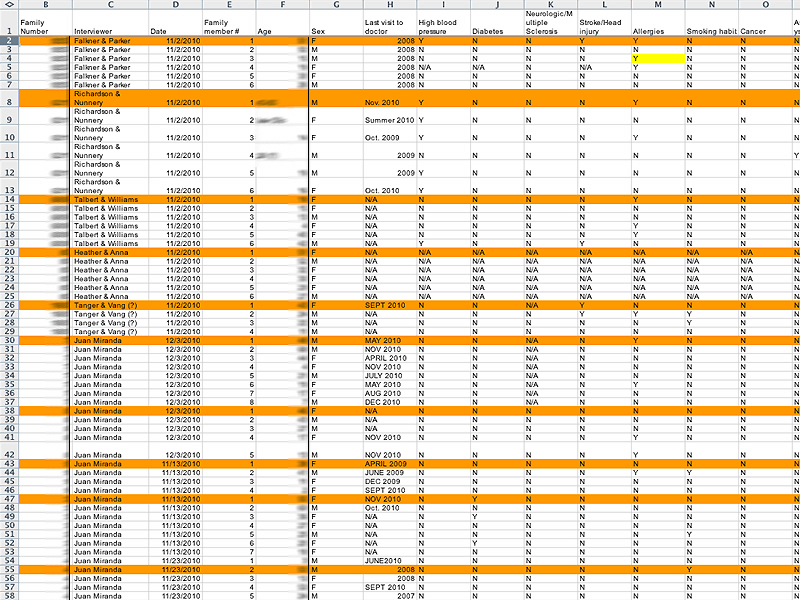
Screening form

This form also asks difficult questions. 


Basic information collected

Selection of participants and interpretation assistance for UNCG research
assistant Juan Miranda, who is working with Dr Stephen Sills. 
_______________________________________

E. Health and Disease Prevention Perspectives...
Sharon D. Morrison, PhD, MSPH
UNCG


Culture and language are key components to good health outcomes. Excerpts from a presentation by Dr Morrison in which she uses the Montagnard population to illustrate how the PEN-3 model could improve community health.


Lay heath workers and other families participate in interviews conducted by 
UNCG graduate students in Dr Sharon Morrison's Public Health Education class.
 _______________________________________


F. Disaster Preparedness Study
Huaibo Xin, DrPH, MD, MPH, 
Southern Illinois University at Edwardsville 
 Disaster Preparedness Study


Presentation to Montagnard Dega Association ESOL class on disaster preparation 
and interview interpretation for Dr Huaibo Xin.
_______________________________________

G. Food Insecurity Study
Jigna Dharod, PhD
UNCG
A Latino food pyramid, based on actual eating habits and food preferences. Creating 
a  comparable Montagnard food pyramid would require closer study of the diet.

 
Assisting Dr Jigna Dharod to research food habits and interview 50 families.
Identification of foods in the Montagnard diet through shopping trips to community stores.
Simple method for interviewing participants about amounts consumed.
Recipe demonstration by the health team

 A Montagnard food pyramid

 BMI chart used by health team

Concept map explaining the relationship of weight and BMI to diet. Community members asked why they had high blood pressure or other health problems if they were not overweight.

Simple education sheet explaining how work and exercise, once one and the same in Vietnam, are now specialized activities in America.

Culturally sensitive questions had to be reframed by the health team. Community members had to believe sensitive information would not be shared.
 
A Montagnard mom during an interview session. 
Mothers have been the focus of the lay health team’s assistance.
Early participants also received cloth samples donated by a textile salesman
_______________________________________

H. Interpretation - Translation - Transcription Method
Andrew Young 

Side-by-side method adopted for US Census


Original proposal for interpretation to translation method. The lay health team would  
learn how to record and the transcribe audio to digital text assisted by technology.

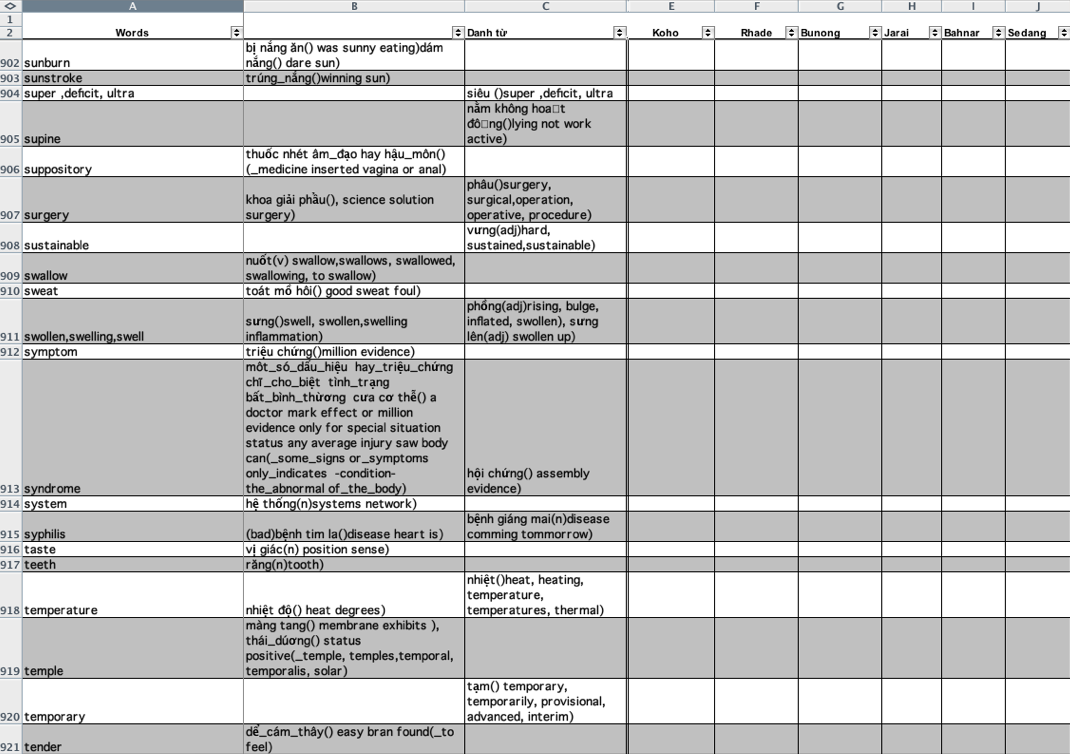
A multi-language, cross-reference data base for medical terminology still in progress.

Training version of the survey used by the health team. The reading difficulty had been reduced from the original 3.5 grade level to 2.2 for easier learning. The survey was redesigned to a fill-in format with a heavy emphasis on bridging cultural gaps.

On the right, another training version of the survey with English and a crude Vietnamese translation side by side. This method allowed the learner better understand the survey questions and adjust her translation to the participant’s education and primary language while she practiced interviewing community members.
_______________________________________
I. Urban agriculture and NCAT food harvests
In 2010, Greensboro was ranked #4 in food hardship in the US.


Past efforts in community gardens
Practicing what she preaches. Health team member exercises by jogging around her new garden beds. It was important for health team members to learn by doing and to give feedback about culturally appropriate ways to communicate good health behavior to their friends and neighbors.
Large garden plot created by one of the lay health workers in her backyard. She used donated seeds from Big Lots, seeds from friends and family, and saved seeds from the previous year.

The lay health team escorted community members to NCAT’s 
demonstration farm to harvest vegetables and deliver them to 
needy families. They picked over two thousand pounds of produce.


Community activist Warren Williams organized harvest events and
coordinated with NCAT and Cooperative Extension office personnel.


Or, we can offer fresh produce to refugees through well-intentioned but otherwise time-consuming and meaningless programs like this one meant to support local farmers. The total coupons available for each family had a value of $12.00.
_______________________________________

J. Education Day
United Montagnard Christian Church
Touger Vang of UNCG speaks to Montagnard children and high schoolers about succeeding as a refugee during Education Day organized by Pastor Y Hin Nie. Many Montagnard high school and college students are enrolled in health and medical programs, but no formal programs exist to assist them or to connect them to existing health projects.

Future leaders. Local universities and colleges could make a bigger effort to encourage and recruit top students in the Montagnard community.
_______________________________________

K. Distribution of school backpacks and supplies
Goat Lady Dairy CSA, Spears Family YMCA
Backpacks and school supplies donated by members of the 
Goat Lady Dairy CSA and organized by volunteers. The lay 
health team selected recipients and helped deliver items.


School supplies donated by Spears Family YMCA, Greensboro. The lay 
health team selected recipients and helped in transportation.
_______________________________________

L. Distribution of emergency food
Girl Scouts
The lay health team visited Girl Scout Troop 41738 (Greensboro), spoke about their lives and their community, accepted their food donations and divided and delivered them to the neediest families.

Food packages ready for deliver.
_______________________________________

M. Orange Card sign-up drive
Project Shine (Reading Connections)
in coordination with
Food Insecurity Study - 2
Jigna Dharod, PhD
UNCG
The Orange Card entitles qualified, low-income recipients to receive health care at reduced cost.

The 12-page Orange Card application form
Visual instruction sheet the health team uses to explain 
essential documents to preliterate community members.


The reverse side of the information sheet targets mothers to obtain indigent health care. 
A sliding scale fee to see a doctor is comparable to buying fast food or cigarettes.

The health team tracks community members who are keeping food receipts or need 
the Orange Card. They also assist women to get food stamps and other needs.

Happy to have gotten it. The mother was laid off from work three months ago. The father works and brings home less than $1500 each month. They have two young children. Recently they moved from their apartment complex to even cheaper, run-down quarters. As the economy worsened, Montagnard workers who held steady jobs for more than ten years were permanently laid off.

The health team also assists families to organize bills, important papers and documents while helping them find Orange Card requirements. This is highly appreciated by preliterate parents. Some families also keep food receipts as part of the Food Insecurity Study - 2. 


Moms as change agents in community health


Staggering bills such as these cannot be paid by poor families. Preventive care 
is the start of cost controls and reduction of health costs to Montagnard families.
_______________________________________

N. Montagnard Health Meeting
Center for New North Carolinian
Inquiries about Montagnard doctors and other health professionals 
 in the community came up during conversations with the lay health team. 


YBhim Nie, proposed study of hypertension in the Montagnard-American community.


Lhiam Enoul, proposed 5-page health checklist translated into Rhade.


Translational research and community-based participatory research presentations 
by NCTraCS attended by Montagnard doctors YBhim Nie and H Wier Siu.
Proposal to bring former Montagnard physicians together to talk with American counterparts and to discuss university researchers’ findings.

–––––––––––––––––––––––––––––––––––––––
II. TAKE HOME: MONTAGNARD COMMUNITY 
A. NCTraCS Pilot Program $2,000 health grant
A grant to investigate a community health problem.

B. NCTraCS Community-Based Participatory Research charrette
An expertly facilitated meeting to generate a fundable, community-based health research project.
C. Montagnard Health Professional Study, Huaibo Xin, DrPH, MD, MPH
A study to investigate the problems faced by Montagnard health professionals.

D. Montagnard Food Insecurity Study, Jigna Dharod, PhD
An expanded study of the food, diet, and health problems experienced by the Montagnard community.
––––––––––––––––––––––––––––––––––––––– 
III. TAKE HOME: AMERICAN COMMUNITY 
A. The lay health team interprets and communicates effectively to a preliterate, multilingual population at 40% of the standard rate ($20 per hour compared to $50 per hour).
B. It frees scarce, highly qualified translators and interpreters to do more important work.
C. As a regular community presence, it reduces costs by making sure patients understand and follow basic instructions, arrive on time, bring essential documents, etc. 
E. Montagnard former physicians and US-trained professionals are the final pieces to a permanent bridge to good health, patient compliance and reducing health costs.
F. Both require modest, stable funding.