
AGGIES HELP NEEDY FAMILIES
MONTAGNARD LAY COMMUNITY HEALTH WORKERS BRING ALONG NEIGHBORS TO HARVEST PRODUCE.

WARREN WILLIAMS HAS BEEN delivering fresh produce donated by great businesses such as Goat Lady Dairy and other local farms to an apartment complex with refugee and immigrant families, giving away great looking peppers, callaloo, tomatoes, eggplant, all kinds of greens and fresh, organic vegetables. The organization he's put together, Food Insecurity and Nutritional Educational Services, has also harvested food and gotten contributions from the Guilford County Sheriff's Department Prison Farm and from many of the community gardens of Guilford County. He's also regularly supplemented Meals on Wheels food deliveries with fresh produce.
After a couple of Saturdays of showing up and distributing food at the complex, he called to say North Carolina Agriculture and Technical State University had produce ready to harvest. Could any of the refugee families assist gathering it? We knew some of the families from ESOL classes we taught at Montagnard Dega Association.

A few phone calls and visits to explain the plan and off we went. We did a couple of excursions to the NC A+T farm off of McConnell Road, once to gather tomatoes, okra, and corn and a second time for butternut squash. While we were out there the Montagnard women also gathered pigweed leaves. The Aggies were very friendly and happy to see the veggies put to good use.

Warren estimated our two trips amounted to over 2000 pounds. The Montagnards brought home plenty to share with extended family and Latino neighbors. Betsy brought some to her Bhutanese ESOL students. A lot more was distributed by Warren to Greensboro city neighborhoods with kids who attend Title 1 schools. Here fresh, healthy food can be scarce. The economic downturn has left families with little money to buy food after rent was paid. The high quality food we gathered reached hundreds.
Butternut Squash Harvest


Tomato, Corn and Okra Harvest


MONTAGNARD LAY COMMUNITY HEALTH WORKERS BRING ALONG NEIGHBORS TO HARVEST PRODUCE.
TOMATO HARVEST SQUASH HARVEST RICE HARVEST PIGEON PEAS, BEANS
WARREN WILLIAMS HAS BEEN delivering fresh produce donated by great businesses such as Goat Lady Dairy and other local farms to an apartment complex with refugee and immigrant families, giving away great looking peppers, callaloo, tomatoes, eggplant, all kinds of greens and fresh, organic vegetables. The organization he's put together, Food Insecurity and Nutritional Educational Services, has also harvested food and gotten contributions from the Guilford County Sheriff's Department Prison Farm and from many of the community gardens of Guilford County. He's also regularly supplemented Meals on Wheels food deliveries with fresh produce.
Rice Harvest, December 1, 2011
After a couple of Saturdays of showing up and distributing food at the complex, he called to say North Carolina Agriculture and Technical State University had produce ready to harvest. Could any of the refugee families assist gathering it? We knew some of the families from ESOL classes we taught at Montagnard Dega Association.

Picking okra.
A few phone calls and visits to explain the plan and off we went. We did a couple of excursions to the NC A+T farm off of McConnell Road, once to gather tomatoes, okra, and corn and a second time for butternut squash. While we were out there the Montagnard women also gathered pigweed leaves. The Aggies were very friendly and happy to see the veggies put to good use.

Squash headed for Betsy’s ESOL students.
Effects of the economic downturn: Recent stats show Greensboro ranks fourth in the nation in food hardship. The News-Record reports that over 91,000 residents of Guilford County, 19% of the population, are now on food stamps. This is a big increase of more than 12,000 since last year. If all eligible refugees could be signed up, the total number of residents on food stamps would be even higher. Interviews with refugee families show food scarcity is far more prevalent than previously thought. If economic recovery is destined to take 4, 5, 6 or 7 more years as some experts are suggesting, then food insecurity will become a permanent problem with long-lasting social effects. Twenty-three percent of kids in North Carolina live in poverty. The overall economy has been bad for middle class Americans and worse for the working class poor. Refugees have an especially bad time because they live in cultural isolation, far off the radar screen of American agencies and authorities.
____________________________________
Postscript: Our big butternut squash harvest was distributed to Montagnard families on the east side of Greensboro who will share with extended family and friends. For the poorest, it gives them a chance to “give back” to friends and families who've assisted them with food and other support while they've struggled. Food Not Bombs took on a lot of squash as part of their food collection that regularly feeds the city’s homeless and needy. Through Montagnard Dega Association we distributed squash to about 30 Southeast Asian refugee families living in the city's northeast.

Post-Postscript: In late October I got another call from Warren, green peppers and some tomatoes were ready for picking. While the ladies and Warren collected a few hundred pounds of handsome veggies, I was holding a few of the freshly picked peppers up to faculty and researchers from NCAT and UNCG, saying the issues of building long term relations and trust with refugee and immigrant communities in order to do social research would not be difficult if the region's institutions could organize their outreach efforts. Our region has the collective expertise and resources to be a leader in refugee and immigrant relations, if only we could align and maximize our efforts.
Related stories:
Refugee Fusion Cooking at CDI: our work with foodies, techies, and refugee populations
Our food collaboration with UNCSA
Food and Diet: A cultural approach to teaching

Another bountiful harvest: A few hundred pounds of green peppers.
Young green pepper leaves were also harvested.
Post-Postscript: In late October I got another call from Warren, green peppers and some tomatoes were ready for picking. While the ladies and Warren collected a few hundred pounds of handsome veggies, I was holding a few of the freshly picked peppers up to faculty and researchers from NCAT and UNCG, saying the issues of building long term relations and trust with refugee and immigrant communities in order to do social research would not be difficult if the region's institutions could organize their outreach efforts. Our region has the collective expertise and resources to be a leader in refugee and immigrant relations, if only we could align and maximize our efforts.
____________________________________
Related stories:
Refugee Fusion Cooking at CDI: our work with foodies, techies, and refugee populations
Our food collaboration with UNCSA
Food and Diet: A cultural approach to teaching
____________________________________
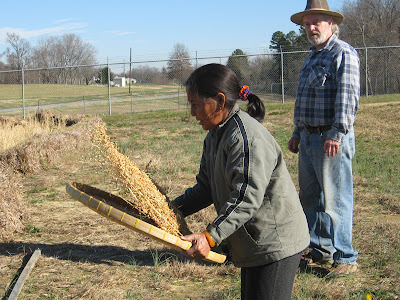
 Three Montagnards came out to demonstrate rice harvesting.




 Arot's dad works at Goat Lady Dairy. Professor Idassi shares some plant knowledge.
 A good food conversation between Khin and Patty.


Rice Harvest


The yield for the small harvest was about 20 pounds.
____________________________________

The Aggies had already piled up the squash by the time we arrived.

We sorted the good from the bad while practicing a little bit of English, too. Some refugees are preliterate — they can't read or write their native language — which makes learning to read and write English a far more difficult task. When you factor in the pressures to obtain employment, it is easy to understand how some refugee and immigrant communities can remain “off the radar screen” for decades. Fathers go off to work but often have little opportunity to practice English in plants that employ many refugees and immigrants. Moms might work, too, or stay at home, taking care of children and grandchildren, unable to get to English classes and rarely going out to interact with native born English speakers.


We quickly ran out of boxes.

Many refugees are resourceful farmers who rarely get the
chance to use their skills after they arrive in the US.

A typical Montagnard farm was about 7 acres.

In Vietnam, farmers raised a very large variety of vegetables
and fruits to feed themselves and cash crops such as coffee.

Families also foraged in forests for wild plants and mushrooms.
Pigweed is in the amaranthus family. The leaves are edible.


We filled a couple of cars and the back of a truck with butternut squash.


____________________________________
Tomato, Corn and Okra Harvest

These women also inspected a small wet rice demonstration project.
Montagnards are experienced growing both wet and dry rice crops.


Although farm work is long and hard, many refugees who feel
isolated and disconnected from American life enjoy the chance
to use their hands and work in the soil.

Picking cherry tomatoes. These kids would like to attend college
but don't have the information or parents’ encouragement.
but don't have the information or parents’ encouragement.


The traditional Montagnard diet is heavy on a very large variety of fruits
and vegetables, rice, and small amounts of protein. Some villages were so
far off the beaten path that standard staples of Vietnamese and Montagnard
cooking like MSG were unknown.


Tomatoes, like many native American vegetables, made their
way to Europe after 1492 and eventually to Southeast Asia.


More than just refugees, more than just farmers. Two of the five main tribes of Montagnards are represented here. One woman is an expert traditional weaver. Two assist as lay health workers for their community. Two are adept survivalists having fled to the jungle and lived there for years. Many survived bombardments and military raids on their villages during the Vietnam War. Among this group six languages are spoken.


