Showing posts with label textiles. Show all posts

Montagnard Reporters at Mosaic Festival

BREAKING NEWS: REFUGEE YOUTH HAVE OPINIONS
PART OF OUR WORK WITH UNCSA DMA-DEGA PROJECT
With a Flip refugees can “talk back” to Americans without first mastering the long checklist of self-sufficiency skills imposed on them.
Simple digital tools like Flip cameras can empower individuals. As part of our collaboration with Bob King and his UNCSA students I gave four young people the assignment to talk about what they saw at an international festival in downtown Greensboro and to interview people we met. They agreed that it would be interesting to ask them the kind of questions they were asked repeatedly, such as Where are you from? How long have you lived here? and Who taught you English?

Today it is common to see people with cameras and video recording devices at public events the world over. What is unusual is to see someone holding a camera and formally interviewing apparent strangers. The interviewer must be a reporter, we think, or have a special duty or job. Our impression might be further reinforced if the interviewer was professionally dressed and was an adult. But in our adventure this was not the case.

Holding a video camera and asking questions not only empowers the interviewer, it makes her responsible.

And participants can say No.

The view of the camera of our youngest reporter betrays her height. She is small.

When you're small everything around you can be alarming and confusing.

Someone who is tall can seem intimidating. In these instances the camera can help the interviewer "level the playing field" by giving the interviewer control of the interview, asking the questions and deciding when it's over.

A camera takes in its operator's unique viewpoint. It can present or "talk about" things that adults generally ignore such as these frightening drawings made by Palestinian kids.

Here is the above image digitally corrected to clearly show the scenes they depict.
-------------------------------------------------------------------------------------------------
The Mosaic organizers objected to the display of these drawings by the Islamic Center of the Triad and wanted them taken down. Undoubtedly they gave good, bureaucratic reasons (“They upset visitors who came here for a good time” etc.) — all of them clumsy, tasteless, heavy-handed, insensitive — in a word, parental.
---------------------------------------------------------------------------------------------------
Postcard from the US Holocaust Memorial Museum, Washington DC, depicting Darfur kids living in refugee camps.

Being a refugee youth here in the Piedmont often means being subjected to a set of questions (Who are you? Where are you from? What are you?) that remind you that others regularly see you as an outsider. For some refugees and mainstream Americans, the solution seems simple. The more quickly the behaviors, ideas, language and visual appearance that make refugees seem different can be erased, the less likely refugees will be asked such questions.

Of course, this is an absurd solution. It is absurd because it is both impossible and racist.

What's the difference between “acculturation” and cultural erasure? The mission of omnipotent American agents is not to erase refugees' cultures here in the Triad, but that’s the way the collective system operates. Broadly speaking, acculturation implies some degree of exchange and sharing between two cultures. In practice, it seems to mean encouraging refugees to learn enough English to fill out forms by themselves, to find their own transportation solutions, get jobs, pay taxes, stay out of trouble and allow resettlement agencies to report them as success stories. Since there are few forums to discuss what could be shared between refugee groups and Americans, individual family survival (“self-sufficiency”) tends to replace acculturation as the benchmark for refugee success. This may help Americans avoid being called racists, but it does nothing to address the core question, When is a family “resettled”?  In the absence of dialog, the default relationship — one of huge power disparities between Americans and refugees — prevails.

This is why matters of empowerment and not just economic self-sufficiency are important to young people, refugees, immigrants, people of color, minorities, etc.
____________________________________________________________


Refugee women armed with Flips tour UNCSA. A simple device like a video camera is a way refugees can “talk back” to Americans without first mastering the long checklist of self-sufficiency skills imposed on them, because a camera has a viewpoint — that is, an opinion — spoken in a universal language.

Skype conference call connecting American and refugee youth. When youth have a voice, they may say things that adults (big surprise!) might not like. Add sounds, music, words and what do you get?

Bom Mondega's breakout CD.  You get cultural expression. You get art. You get opinion.

Push back. Some people belittle culture and artistic expression. They might think that they're decorative niceties, but not as important as making The Other look more and more like themselves. In other words, they're saying their views and reality are more important than say, refugees’. In refugee and immigrant discussions they seek to narrow questions and issues about multiculturalism, remove conflicting or opposing views and frame problems in ways that meet their own organizations’ missions and funding schemes. This is why organizers’ tasteless attempts to remove drawings like the ones shown above are especially reprehensible.

Where's A Good Montagnard Restaurant?

OUR PECHA KUCHA NIGHT AT DATS 2010
October 9, 2010 
Milton Rhodes Center for the Arts, Sawtooth, Winston-Salem

Pecha kucha is a slide presentation in which the presenter shows 20 slides each of which is shown for 20 seconds. The impetus for this presentation came from our desire to give a slice of the refugee experience to a progressive, green and technological savvy audience.


(1) About three years ago we began to study the Montagnard community, working with individuals on a daily basis. When we'd ask, "Where’s a good Montagnard restaurant?" we'd get a shrug. Who'd want to eat our food? they seemed to say. 

(2) Over time we learned that the name "Montagnard" is, like the name "American Indian", a foreign invention that's stuck. Montagnards are indigenous hill people from Vietnam's Central Highlands. And they really like pumpkin. 

(3) A pause. We like to put in a pitch for young people. Here practically nobody knows anything about their culture and it makes these minority kids' lives more complicated than they need be. Guns, drugs, pregnancy and poverty are problems for which worried parents and local agencies have few answers. (PS--The kids here are all really, really nice.)

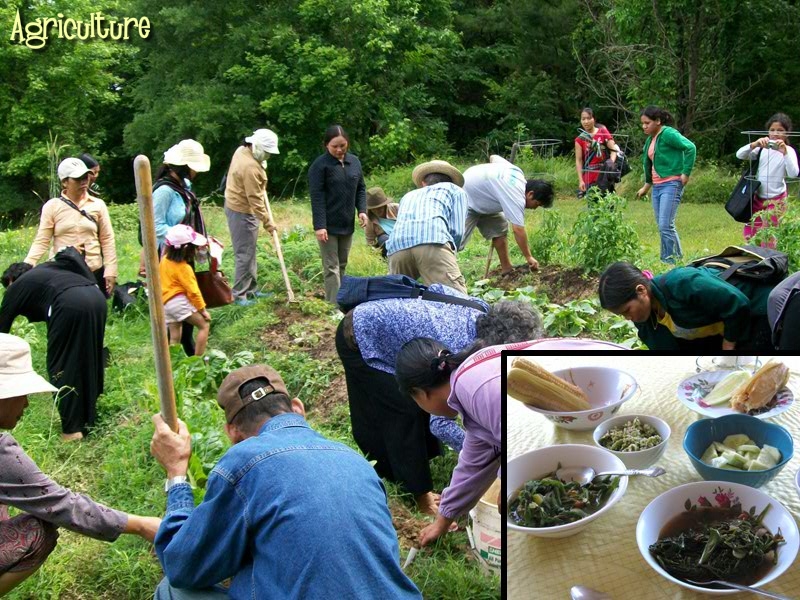
(4) Language and food were two delights of the Montagnards. They had a linguistic dexterity we envied. And what to talk about? Food. As farmers, they knew a lot about growing stuff. 

(5) We were taught how to grow rice and why you can't grow chayote here, how to dry meat and collect river snails. But we puzzled why people who could speak five or more languages would stumble over English. 

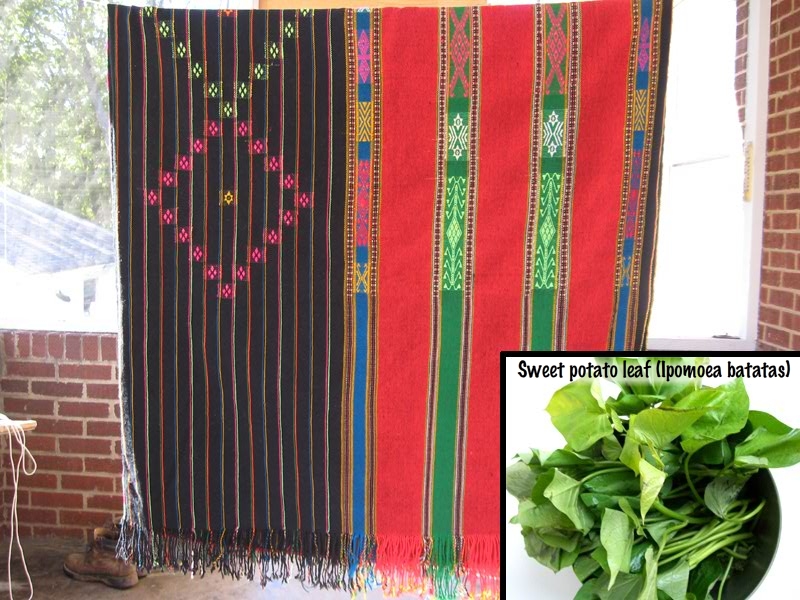
(6) We found their material culture, compared to our American clutter, blessedly compact. It seemed to consist of music and dance, backstrap weaving, agriculture and hunting. And language, which is the most portable of them all. 

(7) C, who missed his family, drew pictures of his father that describe swidden farming, or shifting cultivation, that persisted as late until American involvement in Vietnam, about 1960. 

(8) America, too, used to be a country of farmers who hunted but we don't regard this as living history. We visit that past once in a while, like we visit these re-enactors every March at Tannenbaum Park

(9) So we're startled to see N warping a loom and practicing an ancient art in her Greensboro backyard. She lives in a cramped rental with her husband. She received a French education at the close of the colonial era. She minds her own business and isn't looking for outsiders to validate her work. She's a tough old bird. 

(10) Here's what we could find out. Montagnard food is different from Vietnamese food. Half is like Vietnamese food, but the other half is Montagnard. And hot peppers are indispensable. That's what everyone we ask tells us.

(11) Greensboro was once the center of a textile revolution that transformed the region's economy and turned farmers into factory workers. They bought mill houses and could send their kids to college. By the time the last Montagnards worked at Cone Mills, maybe ten years ago, they were considered good cheap labor.

(12) Despite the Piedmont's past, there are few instances in which Montagnard and American interests intersect in the present. Isolation seems to be why Montagnards learn English slowly, not the difficulty of the language or lack of ability.

(13) The things they care about aren't what we care about. Technologies that no longer have economic value we call crafts and the IRS calls "hobbies". But to these women, it's their culture, which binds all human affairs, including house, farm, clan and community (oikonomikos, economy), into which they pour their deepest expressions, creating art through skillful technical means.

(14) We arranged for some American and Australian backstrap weavers to meet J and N. Language wasn't a problem. Everyone spoke weaving, a global technique thousands of years old. Old N was flattered. At last, she seemed to say, you bring me people I have something in common with.

(15) American refugee assistance prioritizes self-sufficiency -- staying out of the ER, learning English, filling out forms. As far as they're concerned, Montagnards know what self-sufficiency means. They spot edible plants based on their similarity to plants back home. Amaranth, for example, called here "pigweed". We see weeds, they see food.

(16) C's expertise in agriculture has engaged him in a conversation with mainstream Americans. Today he's working at Goat Lady Dairy. He and his wife will still face poverty but his kids stand a chance of making it.

(17) The man who owns this dense city backyard grows food for himself and sells the rest so he can buy what he can't make or grow himself. This is a farming model practiced in Buon Ma Thout or the rural Piedmont decades ago. It's not urban gardening but it has similarities. Who wants to reach out and start a conversation with him?

(18) Ma Ser's store is a meeting ground for people with common interests -- rice, sweet potatoes, noodles, fish, peppers, mangoes. Without those intersecting interests, the neighborhood's Southeast Asians, Africans, African-Americans and Hispanics would not gather as one.

(19) On Summit Ave the Toplois, a Montagnard Koho family, have been busy fixing up a restaurant. Would we finally see a place serving Montagnard food?

(20) Aw, nuts. Maybe one day. 

_____________________________________
 Post Script
Dran Restaurant opened in late 2010. It's in the same building that houses Miyan Toploi's legal office, across the street from Nie's store (Ama Ser). Dran features Japanese hibachi-style and Vietnamese cuisine. I asked the owner if he'd consider offering a couple Montagnard dishes. He didn't say no, but if you go, drop him a hint.

The other day we went there to try some spring rolls and Vietnamese coffee. Everything was good and the interior design made for a very pleasant, friendly feeling. The owners said they were mindful to not use MSG and to keep food healthy. Dran has modest prices. (See the menu below. Click to enlarge.)

We like food variety and we love to see our city become more and more multicultural. While you're there, visit Nie's Asian supermarket across the street and Dega Market around the corner. We support small businesses and entrepreneurs who keep working class neighborhoods alive. When people talk about buying local to support home-grown businesses, they rarely mention ethnic shop owners. Try Dran!

Dran
3113 Summit Avenue,
Greensboro, NC 27405
Phone (336) 621-0341

Washington Post story!
To read about how cool Greensboro is (well, according to one writer) and his nice mention of the Montagnard population and Dran Restaurant, click here.

Warning! Closed on Sundays!