Showing posts with label empowerment. Show all posts

Welcome Center: Stakeholders' Accountability Map

Ay, caramba. — Bart Simpson
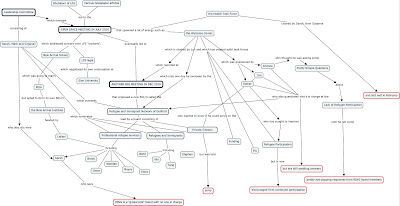
The Evolution of the Proposed Welcome Center for Refugees

Click to enlarge. A miscellaneous collection of known 
knowns and known unknowns. Arcane? You bet.

July 2011
AFTER A YEAR OF MEETINGS following the huge July 8, 2010 Open Space meeting that raised so many hopes and expectations (Sunday July 11, 2010 News-Record, Ministers: Community responsible for refugees), refugee stakeholders haven't figured out how a better system of refugee resettlement could work.

Missing words?  “Road map.” “Vision.”“Empowerment.”“Imagination.” “Excellence.” 

What else? How about “time frame”?

In the meantime, Greensboro has made national news with its #4 national ranking for food hardship, a measure of families’ abilities to buy enough food to eat. Many Greensboro families affected are refugee families.

So what’s the hold-up to progress?
________________________________________________________________
     Reality Test: Three Simple Questions About Community Building
  1. When is resettlement accomplished?
  2. Can refugees list three American references on their resume after being here for (say) five years?
  3. How much does it cost to resettle a refugee in Guilford County?
___________________________________________________________________

We do not need a RING “Communications Network” as some resettlement authorities have pushed; RING already has a private, gatekeepered Website. And everyone knows how to pick up the phone or write an email.

What we need are answers — an independent Information Task Force to field questions, get answers and distribute them to the wider public — from which we will find new voices, better expertise and allies who will be the deciding force that breaks the refugee logjam and forces accountability and change.

Some people seem to suggest that by simply asking questions, challenging resettlement leaders and insisting on evidence-based rules and guidelines we are hurting their organizations’ abilities to help refugees and by extension, hurting the refugees themselves. The same sort of posturing guided Lutheran Family Services as it fell apart a year and a half ago. On that basis alone, refugee resettlement stakeholders should not expect to be taken at their word. No one accuses them of dishonesty but they should feel obliged to explain their operations and policies since the serious plight refugees is of direct concern to all Greensboro.

These are extraordinarily tough times for refugees. If they really care, resettlement organizations should be open to suggestions for significant change. Circling the wagons is not going to get them that help.
___________________________________________________________________

Anticipating Open Space:
Recommendations to the Open Space meeting
Arguing afterward for Culture:
Why Culture Matters to a Newcomers’ Welcome Center
Other attempts at mapping the impossible:
Montagnard Refugee Concept Map

___________________________________________________________________
What They Said Then: July 22, 2010

Good Afternoon everyone, I hope you're all having a good week. I wanted to follow up on two items today. First are some of the upcoming meetings next week and the following week for the Task Forces that emerged from Open Space. There are a couple of other groups who will be meeting and they will send their dates out later. Hopefully all of the information you need is here, but if not please feel free to contact the team leaders listed for more information (and remember to share this with others in the community!)

Secondly at the bottom of this very long email you'll find instructions to join the Refugee Information Network of Guilford. Several of you have contacted us to be added and instead of inviting you all individually, I thought it'd be easier to give you instructions to add yourselves.

UPCOMING MEETINGS OF OPEN SPACE TASK FORCES
Anyone can join these task forces, even if you were not a part of the original group. It would be especially helpful to share this information with others in the community who you know would like to be involved but who were unable to attend the Open Space meeting.

1. Refugee Health Task Force - Tuesday, July 27th at at 10 am at Church World Service 620 S. Elm St, Conference room on 3rd floor (directly across from the stairs/elevator). There is free parking in the lot in front of the building, if this is full there is a gravel lot across the street, street parking, and parking on the side of the building. This meeting will review the plans made at open space and begin to define the scope of work and potential members of the Refugee Health Council. New ideas and reflections welcome! Contact Person: Sarah Ivory - sivory@churchworldservice.org

2. Immigration Legal Services Task Force - Thursday, July 29th at 11 am at the Triton Building at 1031 Summit Ave., Suite 1E2. Free parking in lot in the back. The purpose of this meeting will be to finalize a statement of need that will ultimately be endorsed by affiliates/ cosponsors/ MAAs, etc regarding the provision of legal immigration services to refugees and immigrants. Contact person: Heather Scavone - heather.scavone@lfscarolinas.org

3. Ethnic Community Empowerment Task Force - Thursday, July 29th at 6pm at Church World Service 620 S. Elm St, Conference Room on 3rd floor (directly across from the stairs/elevator). There is free parking in the lot in front of the building. This group is working on ways to increase the voice of the refugee community in the community at large. Their projects include created a refugee leaders council (a focus group that will share information across ethnic groups and be a voice to the community at large), obtaining technical assistance to support the development of new ethnic mutual assistance organizations, and developing leaders. This meeting is being held in the evening to encourage participation from community members who work during the day and would not otherwise be able to attend. Contact Person - Badal Gurung - bgurung@churchworldservice.org

4. Education/ English as a Second Language Task Force - Tuesday, August 3rd at 10am at a location yet to be determined. This group is tackling issues related to access and content of ESOL and education in the community. Contact people: Leilani Forgay-Roughton -leilani.roughton@lfscarolinas.org and Stephanie Baldwin - thecommunitycollaborative@gmail.com

JOINING THE REFUGEE INFORMATION NETWORK LISTSERV
The Refugee Information Network of Guilford Listserv (RING) is a an online email group that was set up some time ago to facilitate information sharing across our community network around refugee issues. Anyone can join the network and if you join you have the option to choose how you receive information. There are probably about 2 emails a week on average (and zero in many weeks) coming from this listerv so you will not be bogged down. It also gives you the option to go to the listserv home page and access old posts, instructional documents (like the refugee welcome packet that provides information about how to do just about everything in our community), updates on arrival numbers and ethnic breakdowns etc. There is quite a bit of useful information on this page already but so much room for this resource to grow.

The easiest way to get on this listserv is the follow these instructions below. If you have problems, just let me know and I'll get a personal invitation out to you. You do not need to have a gmail account to join, but it will ask you set to up a google account using your regular email address if you dont.

Let's hope for some incredibly productive task force meetings next week!
Thanks,
Sarah Ivory on behalf of Leadership Team

Mondega at UNCSA

CONTEMPORARY ARTIST SKYPES WITH UNCSA STUDENTS
PART OF OUR WORK WITH UNCSA DMA-DEGA PROJECT

May 19, 2011. Part of our project working with UNC School of the Arts and the Montagnard community brought together Professor Bob King, his sixty digital media class students and rap artist Bom Mondega, voted MTV artist of the week in December 2010.

Big thanks to H'Rina DeTroy and her diaCritics story on Bom.

Montagnard Reporters at Mosaic Festival

BREAKING NEWS: REFUGEE YOUTH HAVE OPINIONS
PART OF OUR WORK WITH UNCSA DMA-DEGA PROJECT
With a Flip refugees can “talk back” to Americans without first mastering the long checklist of self-sufficiency skills imposed on them.
Simple digital tools like Flip cameras can empower individuals. As part of our collaboration with Bob King and his UNCSA students I gave four young people the assignment to talk about what they saw at an international festival in downtown Greensboro and to interview people we met. They agreed that it would be interesting to ask them the kind of questions they were asked repeatedly, such as Where are you from? How long have you lived here? and Who taught you English?

Today it is common to see people with cameras and video recording devices at public events the world over. What is unusual is to see someone holding a camera and formally interviewing apparent strangers. The interviewer must be a reporter, we think, or have a special duty or job. Our impression might be further reinforced if the interviewer was professionally dressed and was an adult. But in our adventure this was not the case.

Holding a video camera and asking questions not only empowers the interviewer, it makes her responsible.

And participants can say No.

The view of the camera of our youngest reporter betrays her height. She is small.

When you're small everything around you can be alarming and confusing.

Someone who is tall can seem intimidating. In these instances the camera can help the interviewer "level the playing field" by giving the interviewer control of the interview, asking the questions and deciding when it's over.

A camera takes in its operator's unique viewpoint. It can present or "talk about" things that adults generally ignore such as these frightening drawings made by Palestinian kids.

Here is the above image digitally corrected to clearly show the scenes they depict.
-------------------------------------------------------------------------------------------------
The Mosaic organizers objected to the display of these drawings by the Islamic Center of the Triad and wanted them taken down. Undoubtedly they gave good, bureaucratic reasons (“They upset visitors who came here for a good time” etc.) — all of them clumsy, tasteless, heavy-handed, insensitive — in a word, parental.
---------------------------------------------------------------------------------------------------
Postcard from the US Holocaust Memorial Museum, Washington DC, depicting Darfur kids living in refugee camps.

Being a refugee youth here in the Piedmont often means being subjected to a set of questions (Who are you? Where are you from? What are you?) that remind you that others regularly see you as an outsider. For some refugees and mainstream Americans, the solution seems simple. The more quickly the behaviors, ideas, language and visual appearance that make refugees seem different can be erased, the less likely refugees will be asked such questions.

Of course, this is an absurd solution. It is absurd because it is both impossible and racist.

What's the difference between “acculturation” and cultural erasure? The mission of omnipotent American agents is not to erase refugees' cultures here in the Triad, but that’s the way the collective system operates. Broadly speaking, acculturation implies some degree of exchange and sharing between two cultures. In practice, it seems to mean encouraging refugees to learn enough English to fill out forms by themselves, to find their own transportation solutions, get jobs, pay taxes, stay out of trouble and allow resettlement agencies to report them as success stories. Since there are few forums to discuss what could be shared between refugee groups and Americans, individual family survival (“self-sufficiency”) tends to replace acculturation as the benchmark for refugee success. This may help Americans avoid being called racists, but it does nothing to address the core question, When is a family “resettled”?  In the absence of dialog, the default relationship — one of huge power disparities between Americans and refugees — prevails.

This is why matters of empowerment and not just economic self-sufficiency are important to young people, refugees, immigrants, people of color, minorities, etc.
____________________________________________________________


Refugee women armed with Flips tour UNCSA. A simple device like a video camera is a way refugees can “talk back” to Americans without first mastering the long checklist of self-sufficiency skills imposed on them, because a camera has a viewpoint — that is, an opinion — spoken in a universal language.

Skype conference call connecting American and refugee youth. When youth have a voice, they may say things that adults (big surprise!) might not like. Add sounds, music, words and what do you get?

Bom Mondega's breakout CD.  You get cultural expression. You get art. You get opinion.

Push back. Some people belittle culture and artistic expression. They might think that they're decorative niceties, but not as important as making The Other look more and more like themselves. In other words, they're saying their views and reality are more important than say, refugees’. In refugee and immigrant discussions they seek to narrow questions and issues about multiculturalism, remove conflicting or opposing views and frame problems in ways that meet their own organizations’ missions and funding schemes. This is why organizers’ tasteless attempts to remove drawings like the ones shown above are especially reprehensible.

Montagnard Food at UNCSA

SPRING ROLL RECIPE: How food leads to life stories
PART OF OUR WORK WITH UNCSA DMA-DEGA PROJECT


As part of our collaboration with Bob King and his UNCSA students, our two lay health workers demonstrated how to make spring rolls — a decidedly Vietnamese dish —which lead to the telling of a story about living in the jungle to escape war, the scarcity of food then, the importance of food today and her mother's influence. Filmed in May, 2011in Winston-Salem, NC.

Postscript: The storyteller's mother died in Vietnam in June 2011, a month after this video was made. She was probably between 90 and 98 — maybe not quite 100 years old as told in the story — but  clearly the eldest in her village.

Transcription (with interpretation to make the speaker's answers clearer):

Question: How old were you when you went to the jungle?

I was twelve... No eleven years old (in 1979).

I had been in the jungle for twelve years. Then I came to the USA in 1992. Now I'm 43. That was long ago!

I gave birth to two babies — two kids — in the jungle. I gave birth to them myself, no doctor, no people to take care of them. I took care of them myself. I cut the umbilical cord myself, I did it by myself. I took care of two kids in the jungle.

Then one girl was born over here in the USA. I had a doctor over here. Then my family felt hurt. They cried for me. Because why? Because they didn't know where I was. Because some people didn't know. Why did you stay there like that (in the jungle out of contact)?

Then my dad died. I don't know. My mom, my mom's 100 right now. Yeah, my mom's 100 now. She's old, old, very old.

I take care of her right now. I say to her, "I still borrow your money." I tell my mom and dad — my dad is gone now — but I tell my mom, "I still borrow from you."

"Why do you say 'I borrow?'"

Because she took care of me!

Then when I get money— even just a little bit — I send it to her. Yes.

Then I explain to her, "I borrowed your money". But I didn't borrow her money really, but she fed me and took care of me.

So I pay her back.

"When I send this money back to you, I repay you." I say it like that.

She cries. She says I'm a smart girl — but I'm not smart because I didn't want to tell my mom and my dad and my family I didn't want to go to school because I was a girl and it would be better if I help my dad. Yes, I helped my dad.

I helped my mom by farming and helping to feed everybody in the house. When I had to leave there was nothing I could do to help them.

And I went in the jungle so I could not go to school. So now, I don't know how to read and write. But I speak English a little — not a lot — just a little. I speak Jarai, Bunong, Rhade, Koho, Vietnamese and English.

I speak a lot!

Question: Why did you have to go to the jungle?

Why? Because — I don't know. I was too young to understand.

(At another interview Kwol explained that the Viet Cong came to her village a few days earlier and forced her to stand in a latrine up to her neck for a full day, pressing her to give names of dissidents in the Montagnard community.)

I went to work. I remembered helping my dad and my mom and my sister, my ex's sister, my family. I have ten family members. I'm the baby. I'm the youngest so I helped my dad with his farm work.

A man already hiding in the jungle said the Viet Cong are going to take me from the farm. At our farm we grew rice, coffee, and someone was coming to get me. I don't know.

Question: You don't know?

I didn't know anything. I cried and cried. I cried everyday. I stayed in the jungle and the next day I woke up and I wanted to see my mom. Where's my mom? Someone said, you stay here without her. I had my brothers with me, two brothers, but both died. My brother in law died. My sister's son, he died. Then there was only me. Five of us fled to the jungle. But all but me died.

Question: They died of illness?

They died in the jungle. By the Viet Cong they were killed. The Viet Cong killed them.

Then I went back to see my mom because it was a such a long time — in 2003. My mom didn't recognize me.

She said, "You're not my daughter." Yes, it's true. She said, "You're not my daughter."

I said, "No, it's me, Kwol."

"No, you died. Kwol died long ago," she said it like that.

"No, it's me", I said it like that. Then I took her and cried and cried.

I hugged her and she said, "You smell different." Because here in the US it's different than in Vietnam, where there's no food or anything. So that's why she said I smelled different.

But I don't know, I still remember when I stayed in the jungle and I ate food — I ate anything. I still remember this.

Sometimes I when I tell my story to my mom, my mom says, "Yeah, if you don't remember this you'll forget it."

She says, "You'll forget it." 

"You stay in America. You've made a good life."

She says I've got a good life here and freedom. Freedom and I've got food to eat.

"You feed your kids."

My mom tells me that.

Kubler and the Refugee Experience

The survival of the native languages is only an apparent exception to the rule of symbolic extinction.— George Kubler
A poncho from Peru, circa 900 AD

George Kubler's Colonial Extinction of the Motifs of Pre-Columbian Art  (1961) theorizes the relationship between an overwhelmingly dominant culture as it extinguishes a weaker one. Perhaps his model can be used to understand the current situation of refugees and explain the real challenges faced by those who attempt to build, preserve and promote their communities while redirecting the power of those in the dominant culture towards reciprocal acculturation (sharing, mutual respect) and away from benign neglect, coercion, threats or force.

Kubler catalogs the responses of the weak as they salvage whatever they can of their past life while living under the constant pressure and demands of a powerful new culture. Of the five he lists, four should be avoided because they lead to the elimination of the weak by the strong.

“Convergence”, or the convergence of interests between the dominant and weak, is a matter of appearances like the trick of perspective that implies railroad tracks meet in the distance. Those in power are never threatened with face to face encounters with the weak. For the many Montagnard congregations here in the Piedmont, Christianity is an example of convergence, the appearance of shared values between themselves and mainstream churches. Both sides have reasons to maintain the illusion of a common mission but American faith-based organizations and mainstream churches have an especially big stake. They have been in the forefront of refugee resettlement in Greensboro and have recently been subjected to sharp criticism which eventually resulted in one agency quitting the region. A real encounter with all cultural obstacles removed and the playing field leveled would assign blame and reveal the current system for what it is — a mess. So what do Montagnard churches get out this? Surprisingly, they get the freedom to be left alone to tend to their people as they see fit.

Kubler uses the term “explants” to mean the brief continuation of traditional habits or activities (also non-threatening) that eventually whither under the dominant culture. Some refugees believe in the power of amulets and one was amazed that their power could work here in America, protecting its wearer from a hail of bullets during a forced house entry. But it’s unlikely the children of this refugee will share her belief. The remarkable stories of many Montagnards, especially women, are probably destined to go unnoticed and unrecorded however rich their oral culture may be, because the transition from a preliterate society to a collection of detribalized literates (to borrow from McCluhan) is consistent with  funded refugee resettlement practices. What will live on? Probably the selective stories of combat and political struggle as described by Montagnard men who fought alongside Americans and recorded by Special Forces vets who have an interest in the shaping and retelling of these tales. (Notice that the illustration at the end of this entry depicting a Montagnard crossbow breaks with this narrative, suggesting some Montagnards were attacking American forces.)

“Transplants” represent isolated pieces from the weaker culture transplanted into the “soil” of the dominant culture. In the Montagnard community, this literally means growing kabocha squash, bitter melon or water spinach in Greensboro backyards or in buckets and boxes arranged to catch sunlight in the city's rundown apartment complexes. None of these vegetables are in the normal American diet and refugees’ little garden plots are rarely considered a threat to American norms. If local mainstream residents ever discover the healthy benefits of eating a more diversified, locally grown supply of food (that is, if it ever becomes “hip” in Greensboro to eat Thai eggplant, squash tendrils, etc.) then transplanted habits might “take” more firmly in Piedmont dirt. Today the reality is different. Chronic diseases caused by poor diet and lack of exercise plague the Montagnard population, whose health stats more and more resemble mainstream Americans’.

“Fragments” are distantly remembered forms and ideas that might be traced and retraced by survivors who have forgotten their symbolic meaning. Music and the arts can fall into this category. Refugee kids might mouth the words but not understand the context of songs. Weavers might create patterns but forget their origins in a world that has vanished. By Kubler's definition Art, which we tend to associate with reinvention and renewal, instead becomes the signpost of a downward spiral, pointing to the death of a culture. We're reminded of a textile expert who told us traditional weavers in Southeast Asia are dying out as traditional forms and symbols become industrialized, commercialized and sold us tourist items. Here in the Piedmont we see mostly old women, master weavers, with no pupils to inspire. Dock Rmah and Y Suk Bukrong are both skilled traditional musicians who are uncertain who will follow them. Maybe young artists like the rapper Mondega can spark a turnaround by initiating a dialog between generations.


Only the fifth response Kubler cites, “juxaposition”, offers the slim possibility of an intact survival of old ways. Reciprocal acculturation “of which there are very few examples in the history of Christianity” means a policy of listening to the needs and interests of refugee communities and working with them to create joint solutions, even while power disparities remain starkly drawn. A recent suggestion to locate a refugee welcome center at a popular international shopping complex was an example of accommodation in the spirit of juxtaposition. Its quick rejection by refugee resettlement specialists suggests that power, not collaboration or cooperation, continue to underly and guide most decision making about refugees in the Piedmont.

LEARNING FROM KUBLER: WHENEVER REFUGEES SUCCEED IN 
ALTERING AMERICAN BEHAVIOR, THEY HAVE THE CHANCE TO 
PRESERVE IMPORTANT PARTS OF THEIR CULTURE.

Agriculturist to agriculturist: An American farmer 
and ESOL teacher works alongside his students at 
community garden.

Refugee farmers learn about “lasagna gardening”...

... And quickly adopt their skills.

This team started a new community garden in a 
single morning.

International sustainability: Refugee farmers 
attended a Carolina Farm Stewardship Association 
conference on best practices and organic techniques.

Woman to woman: A university researcher is 
shown various food products by refugee women 
at their local ethnic store.

Artist to artist: Montagnard artist shares his portfolio 
on an iPod with a Canadian performance artist.

Artist to artists: A traditional Montagnard musician 
demonstrates before American student artists and musicians.

Youth to youth: University art students Skype with 
rapper Mondega (right), voted MTV Iggy Artist of 
the Week in December 2010.

An Amerasian learns how to tell her life story
 through digital media.

While video documenting a traditional recipe to 
students, a Montagnard woman connects her farm, 
her escape into the jungle, her relationship to 
her mother and the importance of food in her life. 

Electronic media used by refugees from oral societies to 
record their trip to UNCSA. McCluhan would approve.

Craftswomen meet: Two master weavers meet with 
an Australian expert and North Carolina fabric artists.

A Montagnard mom shares her spinning technique.

Communicating by doing. A master weaver from 
Vietnam with only rudimentary English skill
shows women weavers from Bhutan how to transfer 
the warp to the loom. A shared passion to continue 
their craft brought these women together.

Public health grad students interview a community health worker.


Lay health workers help a university
researcher to conduct interviews.

A lay health worker who never received formal
schooling in her country discusses emergency 
planning with her community.

Multilingualism versus ESOL. The celebration of 
the sounds of languages from oral societies. Many 
Montagnards speak 3, 4, 5 or 6 languages.
Translation of Census 2010 paid by a grant from the 
Southern Coalition for Social Justice.

The opening of the largest Montagnard-owned 
store attracted hundreds of neighbors including 
African-Americans, Latinos, and Asians to share 
food and music.

Kitchen to kitchen: A collaboration between refugee 
and American chefs to produce a new dish reflecting 
each chef's food traditions.

An American chef, immigrant chef, and Bhutanese
refugee mom create a collaborative dish.

Refugee and American chefs share the stage.

 
Iraq meets America: A group effort

 Food as a medium for communication. 
The interviewer is a blogger and media 
specialist. The respondent is a refugee
who rarely has the opportunity to share 
her culture with mainstream Americans.


Public presentation of collaborative dishes in Winston-Salem.

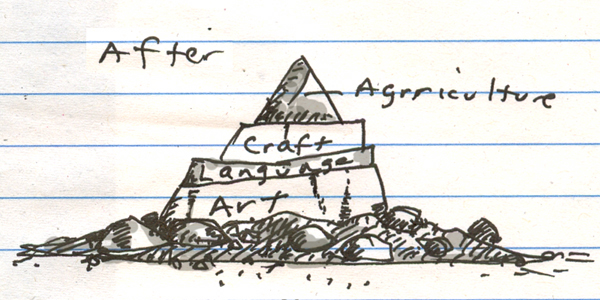
Kubler goes on to explain which bits and pieces are likely to survive cultural cataclysm. In the example of the destruction by the Spaniards of native American culture, he dashes hopes for finding evidence of surviving old customs — so fast, powerful and complete was the overthrow of traditional life. As we consider today how modernity and consumerism have swiftly crushed traditional peoples, Kubler the forensic investigator details the process of destruction and where to look for remains. Original religious beliefs are first to collapse, followed by the arts, then symbolic knowledge such as language. Crafts are rarely viewed by the dominant culture to be a threat and so will persist for a longer period of time. Local agricultural knowledge may be too useful to entirely disappear. Applied to Montagnard culture, we see Kubler's model at work. Christianity replaced traditional religion after decades of war and dislocation and by the late 1960s seems to have been firmly in place, well before refugees began to arrive in the US. Today few women know how to weave and only some recall how to play traditional instruments. The pressures to learn English quickly upon their arrival here in the US cause many parents to worry their children will forget their tribal language. As they punch the clock at the start of their shift at the poultry plant, they may recall their lives as agriculturalists, skilled foragers and farmers with some remaining knowledge about raising plants and caring for animals.

Then they will be Americans. Then they will be just like us. By current standards, this is success.

Culture raffle today. “Apparently there is nothing that cannot happen.” — Mark Twain

The antidote to Kubler’s devastating assessment of Spanish power in the New World is the plea by anthropologist Wade Davis to regard traditional people not as failed attempts to be like us, but rather to see them as equals faced with the same profound questions about what it means to be human. McCluhan specifically identifies artists as specialists able to deal with and respond to collapse, change, and revolutionary technologies. And it is they who most easily connect to the refugee experience because they are attuned to the fundamental cultural struggle they're engaged in. For these reasons, we have supported direct exchanges between refugee and mainstream creatives and artists. To reconsider the presence of thousands of refugees who now call Greensboro or Guilford County their home in this light would be to reconsider the policies and practices that treat them as social problems. It would make us question the agencies that carry out these policies under the banner of faith (or limited budgets) and ask if there are not better models for community building and dialog?

Southeast Asian Bob becomes American Bob, courtesy of Face of the Future

Montagnard Refugee Concept Map

Refugee and Diversity > Make the Pie Bigger  > Montagnard Refugee Concept Map
2011. VISUALIZATION OF A BROKEN SYSTEM
However you arrange the pieces, the whole remains a mess

     VERSION 1.                                         click to enlarge

THIS IS A CONCEPT MAP I created based on a thumbnail sketch we used as part of our discussion about how our group can help the Montagnard community. In this Version 1, I stopped connecting dots among stakeholders after the clutter began piling up and it was no longer easy to track relationships or responsibilities. The resulting visual mess seems to reflect the real life confusion that's derailed almost every refugee initiative of the past couple of years: decentralized network, lack of leadership, difficulty communicating, difficulty understanding boundaries. What has succeeded? Small groups that can work without the network: NAI, Elon Law, Triad Nepalese Community Center, among others.

Above all, it is difficult to explain this tortuous landscape to outside funders, experts, or potential partners who could help. I will play around with the graphic order and try to make a prettier picture in Version 2.

Some preliminary observations: There are many stakeholders (I left off trying to list individual American churches), it is hard to understand the City of Greensboro’s involvement in the Montagnard community and there are no businesses involved except Moses Cone Hospital System. Oh! There's no technology presence. It seems like we've really ceded community building to churches and nonprofit refugee agencies.

I wonder how the Montagnard community would map their encounters with the American refugee system? 

NOTHING TO BRAG ABOUT
A second try at visualizing the refugee system in Greensboro
    VERSION 2.                                     click to enlarge


THIS IS THE SECOND VERSION, “prettier” than the first but no less confusing. I've put Montagnard Dega Association (MDA) in the middle and sought to trace its relations to many of the important refugee stakeholders. Heavily outlined names represent independent stakeholders. Heavy connecting lines from MDA delineate strong relations, dotted lines represent unknown or tentative connections. Admittedly, a lot of this is guesswork, but only because the entire refugee system lacks transparency. 

A NEW VISION, A NEW SYSTEM
To read a one page pitch on why we concentrate on the Montagnard population, see BRIEFS

Jim Keith and I have been conversing about how we can maximize outcomes from limited resources, regarding the Montagnards and other refugee groups.

Here are our working premises:

1. We have focused on the Montagnard community because it represents one of the oldest refugee groups in Greensboro and most likely, the largest. Further, although they have been with us a long time, we have not yet envisioned and created a good system for responding to their needs and interests. We recognize that the experiences of refugees are an integral part of our community. As such, their problems are our problems.

2. We need to work harder to serve the Montagnard group well AND in doing so, create a vision/system that can serve as a model for OTHER refugee groups coming here.

3. As everyone acknowledges, the current system is unsustainable. We believe refugees are not the problem but an important part of Greensboro's future. As such, they must be engaged now in the important business of community building.

4. So, as we acknowledge, learn from, and seek to build on past efforts, we think the time is ripe to CONSOLIDATE and LEVERAGE our group's achievements, to clearly explain a new vision, and build a sustainable model for the future.