Showing posts with label education. Show all posts

Welcome Center: Stakeholders' Accountability Map

Ay, caramba. — Bart Simpson
The Evolution of the Proposed Welcome Center for Refugees

Click to enlarge. A miscellaneous collection of known 
knowns and known unknowns. Arcane? You bet.

July 2011
AFTER A YEAR OF MEETINGS following the huge July 8, 2010 Open Space meeting that raised so many hopes and expectations (Sunday July 11, 2010 News-Record, Ministers: Community responsible for refugees), refugee stakeholders haven't figured out how a better system of refugee resettlement could work.

Missing words?  “Road map.” “Vision.”“Empowerment.”“Imagination.” “Excellence.” 

What else? How about “time frame”?

In the meantime, Greensboro has made national news with its #4 national ranking for food hardship, a measure of families’ abilities to buy enough food to eat. Many Greensboro families affected are refugee families.

So what’s the hold-up to progress?
________________________________________________________________
     Reality Test: Three Simple Questions About Community Building
  1. When is resettlement accomplished?
  2. Can refugees list three American references on their resume after being here for (say) five years?
  3. How much does it cost to resettle a refugee in Guilford County?
___________________________________________________________________

We do not need a RING “Communications Network” as some resettlement authorities have pushed; RING already has a private, gatekeepered Website. And everyone knows how to pick up the phone or write an email.

What we need are answers — an independent Information Task Force to field questions, get answers and distribute them to the wider public — from which we will find new voices, better expertise and allies who will be the deciding force that breaks the refugee logjam and forces accountability and change.

Some people seem to suggest that by simply asking questions, challenging resettlement leaders and insisting on evidence-based rules and guidelines we are hurting their organizations’ abilities to help refugees and by extension, hurting the refugees themselves. The same sort of posturing guided Lutheran Family Services as it fell apart a year and a half ago. On that basis alone, refugee resettlement stakeholders should not expect to be taken at their word. No one accuses them of dishonesty but they should feel obliged to explain their operations and policies since the serious plight refugees is of direct concern to all Greensboro.

These are extraordinarily tough times for refugees. If they really care, resettlement organizations should be open to suggestions for significant change. Circling the wagons is not going to get them that help.
___________________________________________________________________

Anticipating Open Space:
Recommendations to the Open Space meeting
Arguing afterward for Culture:
Why Culture Matters to a Newcomers’ Welcome Center
Other attempts at mapping the impossible:
Montagnard Refugee Concept Map

___________________________________________________________________
What They Said Then: July 22, 2010

Good Afternoon everyone, I hope you're all having a good week. I wanted to follow up on two items today. First are some of the upcoming meetings next week and the following week for the Task Forces that emerged from Open Space. There are a couple of other groups who will be meeting and they will send their dates out later. Hopefully all of the information you need is here, but if not please feel free to contact the team leaders listed for more information (and remember to share this with others in the community!)

Secondly at the bottom of this very long email you'll find instructions to join the Refugee Information Network of Guilford. Several of you have contacted us to be added and instead of inviting you all individually, I thought it'd be easier to give you instructions to add yourselves.

UPCOMING MEETINGS OF OPEN SPACE TASK FORCES
Anyone can join these task forces, even if you were not a part of the original group. It would be especially helpful to share this information with others in the community who you know would like to be involved but who were unable to attend the Open Space meeting.

1. Refugee Health Task Force - Tuesday, July 27th at at 10 am at Church World Service 620 S. Elm St, Conference room on 3rd floor (directly across from the stairs/elevator). There is free parking in the lot in front of the building, if this is full there is a gravel lot across the street, street parking, and parking on the side of the building. This meeting will review the plans made at open space and begin to define the scope of work and potential members of the Refugee Health Council. New ideas and reflections welcome! Contact Person: Sarah Ivory - sivory@churchworldservice.org

2. Immigration Legal Services Task Force - Thursday, July 29th at 11 am at the Triton Building at 1031 Summit Ave., Suite 1E2. Free parking in lot in the back. The purpose of this meeting will be to finalize a statement of need that will ultimately be endorsed by affiliates/ cosponsors/ MAAs, etc regarding the provision of legal immigration services to refugees and immigrants. Contact person: Heather Scavone - heather.scavone@lfscarolinas.org

3. Ethnic Community Empowerment Task Force - Thursday, July 29th at 6pm at Church World Service 620 S. Elm St, Conference Room on 3rd floor (directly across from the stairs/elevator). There is free parking in the lot in front of the building. This group is working on ways to increase the voice of the refugee community in the community at large. Their projects include created a refugee leaders council (a focus group that will share information across ethnic groups and be a voice to the community at large), obtaining technical assistance to support the development of new ethnic mutual assistance organizations, and developing leaders. This meeting is being held in the evening to encourage participation from community members who work during the day and would not otherwise be able to attend. Contact Person - Badal Gurung - bgurung@churchworldservice.org

4. Education/ English as a Second Language Task Force - Tuesday, August 3rd at 10am at a location yet to be determined. This group is tackling issues related to access and content of ESOL and education in the community. Contact people: Leilani Forgay-Roughton -leilani.roughton@lfscarolinas.org and Stephanie Baldwin - thecommunitycollaborative@gmail.com

JOINING THE REFUGEE INFORMATION NETWORK LISTSERV
The Refugee Information Network of Guilford Listserv (RING) is a an online email group that was set up some time ago to facilitate information sharing across our community network around refugee issues. Anyone can join the network and if you join you have the option to choose how you receive information. There are probably about 2 emails a week on average (and zero in many weeks) coming from this listerv so you will not be bogged down. It also gives you the option to go to the listserv home page and access old posts, instructional documents (like the refugee welcome packet that provides information about how to do just about everything in our community), updates on arrival numbers and ethnic breakdowns etc. There is quite a bit of useful information on this page already but so much room for this resource to grow.

The easiest way to get on this listserv is the follow these instructions below. If you have problems, just let me know and I'll get a personal invitation out to you. You do not need to have a gmail account to join, but it will ask you set to up a google account using your regular email address if you dont.

Let's hope for some incredibly productive task force meetings next week!
Thanks,
Sarah Ivory on behalf of Leadership Team

Mondega at UNCSA

CONTEMPORARY ARTIST SKYPES WITH UNCSA STUDENTS
PART OF OUR WORK WITH UNCSA DMA-DEGA PROJECT

May 19, 2011. Part of our project working with UNC School of the Arts and the Montagnard community brought together Professor Bob King, his sixty digital media class students and rap artist Bom Mondega, voted MTV artist of the week in December 2010.

Big thanks to H'Rina DeTroy and her diaCritics story on Bom.

Montagnard Food at UNCSA

SPRING ROLL RECIPE: How food leads to life stories
PART OF OUR WORK WITH UNCSA DMA-DEGA PROJECT


As part of our collaboration with Bob King and his UNCSA students, our two lay health workers demonstrated how to make spring rolls — a decidedly Vietnamese dish —which lead to the telling of a story about living in the jungle to escape war, the scarcity of food then, the importance of food today and her mother's influence. Filmed in May, 2011in Winston-Salem, NC.

Postscript: The storyteller's mother died in Vietnam in June 2011, a month after this video was made. She was probably between 90 and 98 — maybe not quite 100 years old as told in the story — but  clearly the eldest in her village.

Transcription (with interpretation to make the speaker's answers clearer):

Question: How old were you when you went to the jungle?

I was twelve... No eleven years old (in 1979).

I had been in the jungle for twelve years. Then I came to the USA in 1992. Now I'm 43. That was long ago!

I gave birth to two babies — two kids — in the jungle. I gave birth to them myself, no doctor, no people to take care of them. I took care of them myself. I cut the umbilical cord myself, I did it by myself. I took care of two kids in the jungle.

Then one girl was born over here in the USA. I had a doctor over here. Then my family felt hurt. They cried for me. Because why? Because they didn't know where I was. Because some people didn't know. Why did you stay there like that (in the jungle out of contact)?

Then my dad died. I don't know. My mom, my mom's 100 right now. Yeah, my mom's 100 now. She's old, old, very old.

I take care of her right now. I say to her, "I still borrow your money." I tell my mom and dad — my dad is gone now — but I tell my mom, "I still borrow from you."

"Why do you say 'I borrow?'"

Because she took care of me!

Then when I get money— even just a little bit — I send it to her. Yes.

Then I explain to her, "I borrowed your money". But I didn't borrow her money really, but she fed me and took care of me.

So I pay her back.

"When I send this money back to you, I repay you." I say it like that.

She cries. She says I'm a smart girl — but I'm not smart because I didn't want to tell my mom and my dad and my family I didn't want to go to school because I was a girl and it would be better if I help my dad. Yes, I helped my dad.

I helped my mom by farming and helping to feed everybody in the house. When I had to leave there was nothing I could do to help them.

And I went in the jungle so I could not go to school. So now, I don't know how to read and write. But I speak English a little — not a lot — just a little. I speak Jarai, Bunong, Rhade, Koho, Vietnamese and English.

I speak a lot!

Question: Why did you have to go to the jungle?

Why? Because — I don't know. I was too young to understand.

(At another interview Kwol explained that the Viet Cong came to her village a few days earlier and forced her to stand in a latrine up to her neck for a full day, pressing her to give names of dissidents in the Montagnard community.)

I went to work. I remembered helping my dad and my mom and my sister, my ex's sister, my family. I have ten family members. I'm the baby. I'm the youngest so I helped my dad with his farm work.

A man already hiding in the jungle said the Viet Cong are going to take me from the farm. At our farm we grew rice, coffee, and someone was coming to get me. I don't know.

Question: You don't know?

I didn't know anything. I cried and cried. I cried everyday. I stayed in the jungle and the next day I woke up and I wanted to see my mom. Where's my mom? Someone said, you stay here without her. I had my brothers with me, two brothers, but both died. My brother in law died. My sister's son, he died. Then there was only me. Five of us fled to the jungle. But all but me died.

Question: They died of illness?

They died in the jungle. By the Viet Cong they were killed. The Viet Cong killed them.

Then I went back to see my mom because it was a such a long time — in 2003. My mom didn't recognize me.

She said, "You're not my daughter." Yes, it's true. She said, "You're not my daughter."

I said, "No, it's me, Kwol."

"No, you died. Kwol died long ago," she said it like that.

"No, it's me", I said it like that. Then I took her and cried and cried.

I hugged her and she said, "You smell different." Because here in the US it's different than in Vietnam, where there's no food or anything. So that's why she said I smelled different.

But I don't know, I still remember when I stayed in the jungle and I ate food — I ate anything. I still remember this.

Sometimes I when I tell my story to my mom, my mom says, "Yeah, if you don't remember this you'll forget it."

She says, "You'll forget it." 

"You stay in America. You've made a good life."

She says I've got a good life here and freedom. Freedom and I've got food to eat.

"You feed your kids."

My mom tells me that.

Cultural Exchange Changes Minds

06/22/2011 v1
One-Page Position Paper
PDF printable version
 Two very different groups, American art students and local   
 refugees, show how social networking and digital media tools can 
 combine to connect communities.


PIEDMONT CITIES HAVE STRUGGLED to understand refugee and immigrant populations, who remain deeply socially disconnected. Could the arts help? Led by Dr Bob King, more than 50 students at UNC School of the Arts met members of the Montagnard community and collaborated on The Global Village Revisited, an intercultural documentary video project designed to find common ground between two extremes: the highly literate, Western academy and a largely preliterate refugee community. Musicians, actors, stage technicians, dancers and filmmakers were energized through their discovery of a people who shared their passion for the arts and rediscovered the meaning and importance of culture.

Events included…
• Traditional musicians like Rmah Dock, 1996 NC Heritage Award recipient
• Skype conversation with Mondega, MTV artist of the week
• Urban farming as practiced by Montagnard war veteran Thomas Eban
• Montagnard refugee resettlement overview presented by Dr Raleigh Bailey, CNNC
• Womens’ perspectives: Storytelling through cooking
• Backstrap weaving at Glenwood neighborhood’s Glenfest
• Mosaic Festival celebrating refugee and immigrant diversity in Downtown Greensboro
• Memorial Day at the Asheboro Dega Farm
• Meeting community members at MDA’s ESOL class
IN A COURSE SURVEY, EVEN THOSE WHO SAID “NO” HAD THEIR VIEWS CHANGED*
* Participants who answered No to either or both end-of-course questions: 1) Did you enjoy and learn from the class project? 2) Do you think it would be good to continue this project next year?
• I did enjoy the exposure to the culture....
• I ended up really enjoying the interaction with the Montagnards...
• At first, I was kind of unsure about the whole thing... but I ended up really enjoying it, and I think I took a lot from it...
• It was a great experience that I would otherwise have never been involved with...
• … Learning about a different culture and actually getting to speak with them and ask them questions was very interesting to me. I went out to the festival in Downtown Greensboro and I found it extremely enjoyable. I absolutely plan on going back next year...
• I didn't know anything about the Montagnards before start of this class. It was SO interesting (especially because I'm not from here, just like them)... it was awesome to learn about them.
TOTAL RESPONSE WAS OVERWHELMINGLY POSITIVE
• 87% of participants said they benefited from the project.
• As artists, they are natural agents of change.  They are inspired by diversity; they inspire others.
• Digital tools powerfully changed the way they viewed and defined their communities.
• Documentary approach and field trips challenged participants to get out of their “comfort zone”.
• Finding and creating stories — not sound bytes or digital fragments — returned them to Marshal McCluhan’s Global Village and the roots of the performing arts.

Design and American Assumptions in Refugee Education

(Refugee and Diversity Projects) > Health > Design and Assumptions


Am I fat? is the starting point for health education and good outcomes


American information designed for a general audience is adopted haphazardly for refugees.

For unique populations such as the Montagnards, who speak as many as 6-8 languages but are often preliterate (unable to read or write), such a design approach with its underlying assumptions often fails, even if it succeeds with other, more literate or empowered ethic groups.

Design is inherently connected to culture. The more Americans forget this, the more likely their designs will fail to communicate. In the example given below there are likely to be additional negative consequences such as resentment and frustration on top of failure to follow doctors’ recommendations. Here is a follow up form for  blood glucose screening (testing for high blood sugar, a sign of diabetes):


Here the client is told to make an appointment to see a doctor, a typical recommendation. But if she is poor and without insurance (likely) then what is the chance of follow through? She may defer to the doctor or clinician and not ask questions. If she is with an interpreter friend, the friend may not wish to offend the health professional or admit their inability to pay. The design flaw here is that it does not anticipate these reactions and offers no options.


In this example, the client is asked to reduce risk by changing lifestyle. The majority of Montagnards were farmers used to hard, long days in the field. When they come to America they rarely engage in equally physically demanding work and lead sedentary lives holed up in small apartments. A farmer measures her physical labor differently than the American office worker on the treadmill during her lunch break. Unless she is shown how to jog or do a workout, a refugee will probably not understand exactly what “regular exercise” actually entails for a modern urban dweller.


Click to enlarge

The above flowchart starts with the question, Am I fat? because this was how the women of the Montagnard lay health team approached the problem of diseases associated with diet and lifestyle choices. We followed their question with a talk about BMI and how to look it up on a color-coded chart.

Once we established an objective baseline for weight, we then went on to discuss how could someone of normal weight still have significant health problems, a puzzling question to them because while they knew of many sick community members, few were overweight or obese. 

The chart then asks about diet, whether one has a poor diet or one of balanced meals, terms also used in a food insecurity interview they have been helping with. Finally, the chart identifies foods used in Montagnard cooking as possible high sodium culprits and links them to certain diseases like diabetes.


Through this chart we sought to link a simple question, Am I fat? to weight, food choices, lifestyle and disease. We approached it from the Montagnards’ viewpoint, taking into consideration their knowledge and understanding of the problem as they experience it through the illnesses of their family members, friends and neighbors.

It is possible to effectively communicate with a preliterate, multilingual community and obtain positive outcomes, but only if American designers are willing to incorporate Montagnard views and cultural ideas. Mere translation of existing English language or text is grossly inadequate. One experienced refugee worker insisted that rules (in effect, design guidelines) should be established for all refugee groups (one shoe fits all). Such a policy is certainly convenient for her office and reduces the workload for her staff. But it's unlikely to yield good outcomes.

STSB: YouTube Demo


SURGICAL TECHNOLOGY SKILLS BUILDER (STSB) was a 2009 serious game created with a team of collaborators from the Piedmont's colleges and universities. I put together the project, which was funded  through the Piedmont Triad Partnership’s Department of Labor WIRED grant, and oversaw its production.

The game is simple but effective, concentrating on key stumbling blocks student learners encounter: identifying instruments, knowing their use, setting up a Mayo Tray, and working under pressure  in a simulated surgery environment.  (more)

Diet, Food and Health Concept Map (Updated)

(Refugee and Diversity Projects) > Health > Diet, Food and Health Concept Map

A MONTAGNARD-CENTRIC APPROACH TO DIET AND HEALTH

Newer version. Click to enlarge.


Old version. Click to enlarge.
__________________________________________________________________

BMI chart. Click to enlarge
__________________________________________________________________

Background
I trained a Montagnard women’s lay community health team to assist UNCG researchers contact families, schedule interviews and interpret. A survey about food insecurity required the team to understand the relationship of behaviors and lifestyle choices to health problems in their community.
__________________________________________________________________

THIS MAP CONTAINS TERMS I used and developed to explain the relationship of key concepts contained in a Food Insecurity survey. The map could have started at any point, but I started with the question the Montagnard women health team asked, “Am I fat?”, when they asked me how they could lose weight.

What worked? they asked. Diet tea? Brown rice? Weight pills?

Why did they wish to lose weight? I asked.

How do you know you’re fat to begin with? led to the concept of BMI, how to read a BMI chart and how to use a scale and how to measure yourself. Then these exercises were carried out in Betsy's MDA ESOL class the next day with community members and the women working side by side. The next set of questions from the women came the day after, asking if many people they tested seemed to have BMI numbers then why was there so much illness in the community, like high blood pressure, stroke, diabetes, etc? At this point, they had arrived at the same place as Jigna Dharod, the researcher who assigned them to conduct the survey.

Now they could understand why the Food Insecurity survey asked community members about what they ate and when, where they shopped, and what did they eat in Vietnam. Fatness leads to all kinds of major diseases in Americans, but for the Montagnards it appears heavy salt is the culprit, along with far less physical exertion and exercise. For weeks we studied these questions, their meaning and how they related to their experience in Vietnam villages, in the jungle and here in the US. By looking at it from their viewpoint and walking their path towards understanding, I believe the women have a far stronger idea of the influence of diet on health than they would have had we kept to American health literature, explanations, and cultural ideas.
__________________________________________________________________

Related

Culture First


9. Cultural Preservation Working closely with partner Betsy Renfrew, and Pastor Y Hin, we are developing a project to help refugee women from Southeast Asian preserve backstrap weaving and promote its practice.
     • Kubler and the Refugee Experience
     • Backstrap Weavers Web site
     • Ju Nie at the Green Hill Center Winter Show 
     • A Spring 2011 project with UNC School of the Arts digital media classes

Montagnard community members have kept copies of historical information. Along with other existing translated texts, these could form the raw material for native language classes, an interest expressed by leaders.
     • A 1939 Rhade Primer
     • A Vietnam War-era Bunong phrase book

Visual memory can also help preserve the past.
      • See Chram's drawings

Music is connected with dance.
      • A rehearsal of ching (gong) players before the Dega Weatherspoon event.

American vets who supported resettlement of Montagnards are getting older and may be interested in looking back at their shared past and considering the future of the Montagnard American community.
     • We've just started making contacts


Business and Jobs


7. Sustainable Business
Urban ag at the intersection of health, job training, literacy and economic development. (more) 
      Refugees have green skills we’re not using 
      • Montagnard Dega Association helps at Dunleith community garden
      • Coffee Shop thanks MDA ESOL students
      • MDA ESOL students learn English while prepping a garden

 Goat Lady Dairy plans to employee Montagnards through its CSA model.
      • Goat Lady Dairy photo documentation

Refugees need to have the same tools as mainstream Americans to get jobs.
      • Resumes for refugees

Collaborative Process: Refugee Community Health Team

(Refugee and Diversity Projects) >Health > (Overview: Refugee Community Health Team) > Collaborative Process: Refugee Community Health Team 


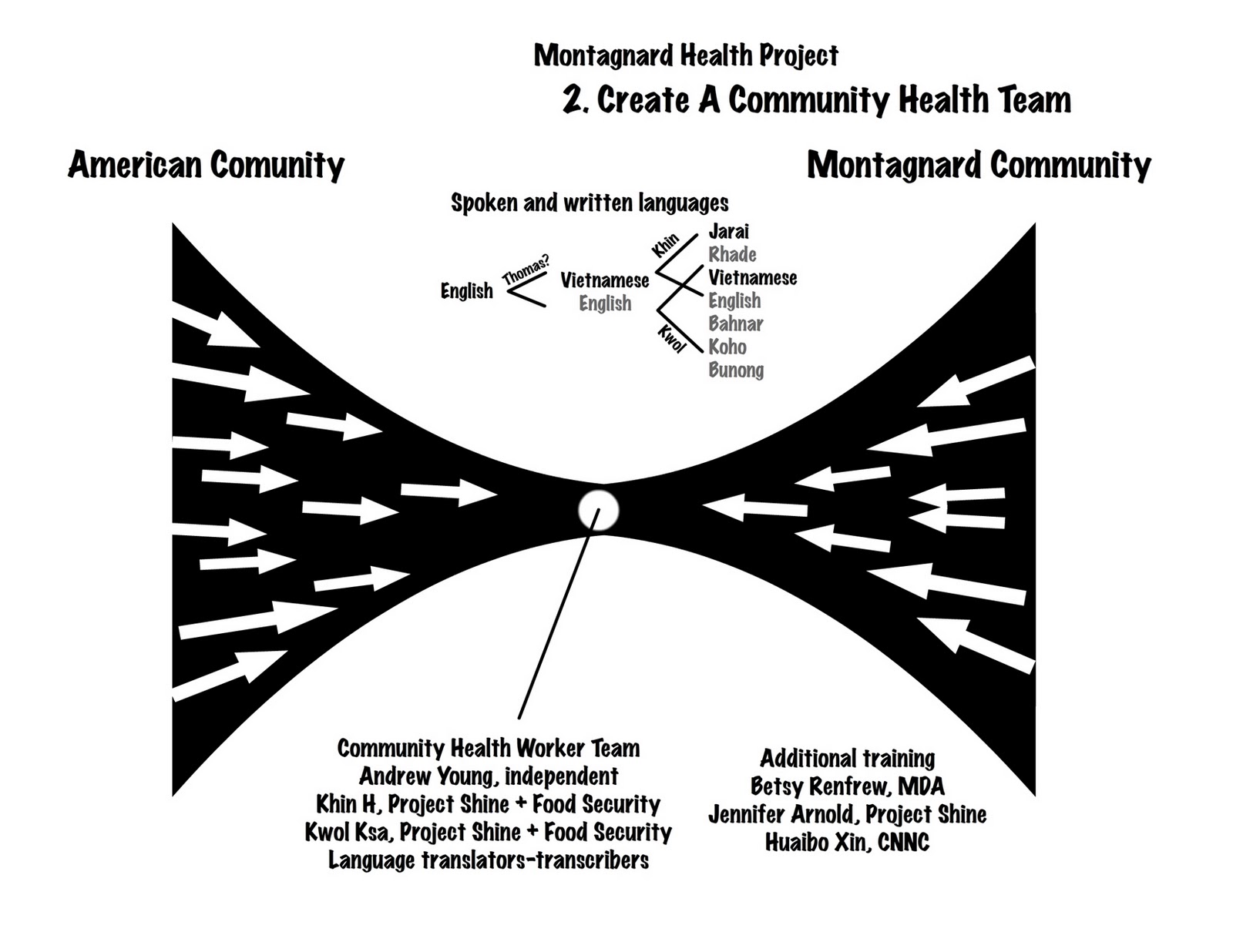
A COLLABORATIVE PROCESS BUILT ON MUTUAL INTERESTS

December 2010. Khin H and Kwol Ksa wear their UNCG badges identifying them as community health workers and carry their university bags for the first time.


These graphics were used to explain how multiple resources and interests could come together to make permanent inroads into the Montagnard community for the purposes of data collection, information exchange, and improved community health. In November 2010, I got the go-ahead from UNCG's Dr. Jigna Dharod and Project Shine's Mandy Benson to proceed with training.

1. Data Gathering Problem. For the American side to collect data required it to overcome the longstanding bottleneck created by difficult language and cultural problems.

2. Create a Community Health Team. I proposed that a health team created specifically to address language problems could help increase the flow of data from the Montagnard to the American community. Only through a team approach could we cover all the languages and cultural nuances represented in the Montagnard community. I further proposed that women with the time and motivation could be trained to conduct health interviews. The costs of their training would be offset by the value of the data they could gather and the permanent inroads they could create.

3. Long Term Capacity Building. Over time, as the team's education and experience grew, it would open the bottleneck and facilitate more exchanges.

4. Stakeholders in the Community Health Team. For the first time, we could figure out how overlapping interests could help fund and get started the organization and training of a health team.


5. Time Line. The health team will aid in the completion of specific data-gathering surveys as well as help with general health information and health literacy training in the community.

Community Blood Pressure Clinic

(Refugee and Diversity Projects) > Health > Community Blood Pressure Clinic


Through Reading Connections and the Montagnard Central Highlands Church, MDA recently participated in a blood pressure clinic. Many adults in the Montagnard community have high blood pressure. Some are not aware that diet, exercise and reduction in smoking endanger themselves and their families.

•They do not realize certain popular condiments and other products essential for Southeast Asian cooking have high concentrations of sodium. See examples we show our clients.

•Men may regard outdoor work such as roofing as exercise and women may say they are too busy with running a household.

•They may not be aware of the dangers of second hand smoke to non-smokers. One client said her husband smoked 5 packs a week. Even if most of that was done at work, smoking at home brings smoke exposure to everyone.

Improving individual and community health means changing behavior. A lot has to happen before an individual or family decides to change; if it was a simple matter of informing people of health risks, there'd be no obesity, diabetes, hypertension, AIDS or drug and alcohol problems in the US.

We know enough now about health and behavior to imagine what it might take to improve the Montagnard community's health (besides the obvious, affordable care). These might include involving groups rather than relying on individuals' own commitment to daily exercise, friendly competitions, the support of churches and schools, etc.

But what precisely might work for the Montagnard community?

Bill Moyers, the PBS host, has had several programs about health and healthcare in the US. Below are links that showcase one way in which a minority community decided to make health a priority.

Dr America Bracho, and how she got her community to deal with diabetes:
http://www.pbs.org/moyers/journal/10162009/watch2.html

On promotoras ("promotors") as effective community organizers:
http://www.pbs.org/moyers/journal/10162009/brachoexcl_flash.html

Does DATS Have A Future?

I SAY POTATO, YOU SAY TOMORROW: LESSONS LEARNED
The symposium has the potential to contribute to the Triad's recovery, but it can't as long as it's passed from city to city each year without permanent management.  Getting local governments to work together is hard; getting artists, creatives and technologists together should be easy. It's time the principals decide what DATS is for. (MORE --->)

                                                                DATS 2010: FOOD FOR THOUGHT
                                                                CENTER FOR DESIGN INNOVATION / MRCA

• DATS 2010 OFFICIAL SITE
A terrific space with excellent views of downtown Winston-Salem, lousy sound, noisy AC, good parking. This is the space’s third makeover so you have to wonder why basics are still a problem. Too bad the cafe wasn't open. The Milton Rhodes Center for the Arts? Okay, but we bet everyone will just call it what it's always been — the Sawtooth Center.


MY DATS 2010 PROGRAM EVENTS 

• Overview and working premises
Two visions about DATS. The first, about establishing it as a credible venue for important ideas in the Piedmont. The second, about expanding its audience by choosing themes that reflect larger community interests and explain economic value.

• DATS MASHUP Cooking Collaboration
Four teams each consisting of an American chef and refugee cook, working with the locally developed purple sweet potato, created dishes that combined the skills and traditions of two worlds. Through this project we demonstrate that food is a cultural medium that can overcome language and other barriers that have prevented the talents and economic value of refugees from being fully realized.

• MASHUP CONTINUES: Connecting Refugees, Breaking Isolation
The project didn't end on presentation day. It was a jump-off point for refugees to socially connect to mainstream Americans. As artists who've studied the refugee community, we see cultural isolation as a barrier equal to if not bigger than language and employment issues. At our blog, we follow the refugees and participants since the public presentation.

• PECHA KUCHA NIGHT: Where's a Good Montagnard Restaurant? 
We ask a single question and discover the complex relationship this unique refugee group has with food.

• WORLD FOOD in the Triad
Guilford County in North Carolina is the state's number one resettlement county for refugees, but residents don't see local innovations and interests in food, farmers markets, new ethnic restaurants, shops and businesses as a reflection of the region's explosive diversity or a source of economic growth.


• Food Geography

PREVIOUS DATS EVENTS
DATS 2009 High Point University
• Our Pecha-Kucha show     
20 slides, 20 seconds each, a new elevator pitch

DATS 2008 UNCG, Greensboro
• Transforming the Triad
The digital divide comes to town
• Are we bleeding talent?
Thank God for youngsters

DATS 2010


 The Milton Rhodes Center for the Arts at the Sawtooth, downtown Winston-Salem


Design, Art + Technology Symposium (DATS) is An Annual Piedmont Event About Important Ideas. Hosts include the Kenan Institute for the Arts at UNCSA, UNCG, High Point University, and the Center for Design Innovation. With the 2010 theme, Food For Thought, we’ll open at the Milton Rhodes Center for the Arts in the newly renovated Sawtooth building in bustling downtown Winston-Salem. Food For Thought will engage timely issues with an influential audience from the region’s businesses, non-profits, educators and government. Meet innovators and trend-setters involved in everything from alternative food to new crops, from agricultural heritage to environmental green, from Southern hospitality to urban sustainability. Inspired by designers Charles and Ray Eames and their film, Powers of 10, they will consider the power of food to transform the daily life of our region. 

It's getting close! DATS 2010 is coming together as a combo local-regional event, with plenty of grassroots energy and organization. (This year will be a breakout event: DATS will move out of academia and into the real world!) Food is about culture. It is one of those rare, big tent themes in which everyone in the Piedmont has an interest. Everyone can bring their experience and know-how.
     The best gardener I knew was my grandmother. The most flexible cook I knew was my mom. Both were frugal and could do a lot with a little. In my view, those are high standards for designers, artists, and technology innovators, whether in good economic times or bad.


Recreation of a UN shelter, food and water at Festival Park.

The Challenge of DATS
The symposium is an annual event seeking to build a legitimate creative movement in the Piedmont. It answers a severe problem: With Charlotte, RTP and the Triangle all within easy drives, the area has suffered from brain-drain. Both Greensboro and Winston-Salem have seen revivals of their downtowns, nightlife and cultural activities, but the economic downturn has highlighted the unfinished work necessary to permanently change the area's future. Quite simply, the Piedmont has to figure out better ways to attract smart people and businesses and keep its brightest youngsters here.

DATS hosts include High Point University (High Point), UNC School of the Arts and Center for Design Innovation (Winston-Salem) and UNCG (Greensboro). Other colleges are associated with the event. I've been a supporter of higher ed's role in promoting regional growth but a steady critic of the event's smallish concentration on events and programs intended mainly for students.

In 2010 I proposed the food theme, a big-tent approach intended to excite and gather many diverse participants. While dollars are scarce, I have also advocated ground-up, community-based and local organizations' participation. The Piedmont is doing interesting innovation in the area of food, but you have to look hard. As usual, groups are somewhat isolated, duplicative, and unaware of overlapping interests. DATS 2010 is an opportunity to pull groups together.

Above: The Edible Schoolyard at the Children's Museum, with the Greensboro skyline in view, just months after Alice Waters’ visit. Below: Refugee guests at Weatherspoon Art Gallery, UNCG.


Regionalism Still Involves Herding Cats

The following appeared as a Counterpoint in the News-Record, Wednesday, September 1, 2010.

It was refreshing to read accounts of the Piedmont Triad Partnership by Keith Debbage and Rob Bencini (Aug. 4). Both are right about PTP. They ask tough questions about the rhetoric and reality of regionalism that PTP and all leaders should answer.

For readers who don’t understand the point of regional economic development, it’s simple: Greensboro, High Point and Winston-Salem will do far better pooling resources to attract and develop growth than trying it on their own.

In 2008, I was hired by PTP to create a team of educators from the region’s colleges and universities to make an interactive training module for surgical technicians. That is, we were going to make a computer game, an otherwise expensive exercise no single institution could afford.

I knew what I was getting into. One teammate described my job as “herding cats.” A business colleague later confessed PTP would have had to pay her triple to do my job because it looked like “Mission: Impossible” through most of it. By the project’s end we had solid, notable successes and some mixed results — not enough to declare victory and start a game industry here in the Piedmont, a dubious PTP ambition, but more than enough to show what we needed to do if the region was serious about attracting and developing businesses that used high-tech skills like those found in the game industry. And more than enough to show what teachers needed to know to be more effective in the classroom.

If I’m certain we had a positive local impact, I’m less certain PTP came close to big-scale change. Even our small project gave PTP considerable leverage to maximize our results because it paid higher education’s tab for faculty training, no small gift in tough times.

With millions from its Department of Labor grant it could call the shots, bring everyone to the table, and enforce discipline and Kumbaya teamwork. That’s herding cats on a grand scale. Now that the grant’s done, we shouldn’t be surprised to see old ways return.

In baseball, everyone loves the drama of a homer, but there are other ways to score. My team hit the ball and, as we round second, we’re wondering if the new PTP management has the keen eye and experience to spot an inside-the-park home run. We blasted the ball high up, it’s just hit the wall and we’re running, running, waiting for a sign.

DATS: Urban Agriculture

PANEL DISCUSSION
Reynolds Place, MRCA
Monday, October 11, 2010
10:00—11:30 am

Children’s Museum’s Edible Garden against the Greensboro skyline.
DURING WORLD WAR II, Victory Gardens provided an estimated 40% of the nation’s fresh fruits and veggies; today, with issues of food security, both locally and globally, will urban agriculture once again provide us a simple tool for living in a rapidly changing world? Does it have the power to unite people regardless of age, race, ethnicity, religion or creed, in a movement to fight climate change? Join us as we discuss the benefits, challenges and possibilities of urban agriculture in the Piedmont, and learn about ways you can get involved in your community.

Panelists Include
Dawn Leonard was originally from Wisconsin. She found her way to the South after meeting her husband while in the Peace Corps in Jamaica. Upon returning to his home of North Carolina, Justin and Dawn moved to Greensboro in 2005. With a BFA in Graphic Design from Iowa State University, Dawn began a career in Greensboro as a graphic and web designer. But the creative spirit often leaves one searching for new ideas, and being an idealist, Dawn found that getting her hands dirty was spiritually more fulfilling. In the transition from artist and professional designer to urban farmer, Dawn has found the commonality of these kindred vocations. In 2008 she co-founded Urban Harvest, a nonprofit in Greensboro dedicated to urban food production, distribution and education. Starting a nonprofit can be an overwhelming challenge, but Dawn believes that important work is often the most challenging, and it is the challenge and passion for our future that drives her forward. She embodies the creative force, not being afraid to take risks or lead us in a new direction. Experience from the Peace Corps, to a summer-long internship at an urban farm, to teaching yoga at Guilford College has led Dawn to a new path of healing the body, the Earth, and our communities.

Justin Leonard is an experienced urban farmer who also is Garden Manager at Edible Schoolyard, part of the Children's Museum on downtown Greensboro. The Edible Schoolyard received national news coverage when Alice Waters, renowned chef, author, and Slow Food advocate came to its groundbreaking ceremony. Justin also a founding member of Urban Harvest and responsible for residential edible landscaping projects.
Kat Siladi works with the Edible Schoolyard at the Greensboro Children's Museum as the Garden Educator and Intern and Volunteer Coordinator. She has a degree in Peace and Conflict Studies and Ceramic Arts from Guilford College and she has recently finished a part-time Americorps term working to make the museum more accessible to immigrants and refugees from the area. Her interest in food education lies in teaching children and families lost knowledge of food production and connecting food production, from seed to table, with multiculturalism and other social issues.

Roland McReynolds (moderator), is executive director of the Carolina Farm Stewardship Association (CFSA). Roland grew up on a farm in central Missouri. After graduating from the University of Missouri-Columbia with BA and BS degrees in History and Political Science, he earned his law degree at the University of North Carolina School Of Law and is licensed to practice in the state. He spent almost 10 years in the legal publishing industry, and spent one year exploring local and sustainable food systems in Europe, before coming to work for CFSA. Roland serves on the North Carolina Certified Crop Advisors Board and the Advisory Committees for the North and South Carolina Sustainable Agriculture Research and Education programs.
Dunleith Gardens, Greensboro, NC
More About CFSA

The Carolina Farm Stewardship Association is a Pittsboro-based organization of 1,000 farmers, gardeners, consumers and businesses in North and South Carolina committed to sustainable agriculture and the development of locally based organic food systems. Founded in 1979 by farmers, gardeners and consumers to support one another and foster the growth of organic food, the Carolinas Farm Stewardship Association (CFSA) has grown into a non-profit with more than 1,000 members and seven regional chapters: six in North Carolina and one in Upstate South Carolina.

In December, the CFSA’s 25th annual Sustainable Agriculture Conference will be held in Winston-Salem. This year’s theme this year is, “Local & Organic Arrives: Our Opportunity is Now.” Local and organic food is at a popularity level that proponents would have only dreamed of a few years ago, and the conference will explore how the movement will seize the opportunity and take it to the next level. The keynote this year, author, attorney, economist and entrepreneur Michael Shuman, one of the nation's leading voices on "buy local" and serves as research and economic development director for the much-heralded Business Alliance for Local Living Economies (BALLE). He will offer compelling and provocative ideas about this important topic.

(photos: Children's Museum: Andrew Young; Betsy Renfrew: Dunleith Gardens)

DATS: World Food in the Triad

PANEL DISCUSSION
Reynolds Place, MRCA
Sunday, Oct.10, 2010
3:00 — 4:30 pm


YouTube: All roads lead to food (How one refugee group thinks about food)

YouTube: H Bec talking about her garden (What's growing in a refugee's backyard?)

Guilford County is the largest refugee resettlement county in the state. About 50-60,000 of the area’s 430,000 residents are immigrants or refugees. How have new populations from all over the world changed the food landscape of the Piedmont? What can we learn from our neighbors? How have their food traditions contributed to the explosion of food diversity we now see in ethnic food stores, restaurants and farmers’ markets? What is their economic and social impact?

In this panel discussion we will explore how our ideas about food
reflect our ideas about culture — ours and those of immigrants and refugees. Most discussions about immigrants and refugees are about problems. North Carolina's obese population now tops 25+%. What solutions might we find amongst immigrant and refugee diets, foods, traditions and lifestyles as we struggle with staggering health issues and their consequences?

PARTICIPANTS
Jigna Dharod, PhD is Assistant Professor, Department of Nutrition at University of North Carolina Greensboro. Her research interests include understanding the different coping mechanisms low-income families use to reduce the severity and incidence of food insecurity; determination of the relationship between food insecurity and social capital and its influence on health outcomes, such as body weight among different immigrants and refugee groups in the US; the use microbiological and other indicators, such as attitude towards food safety, to understand food safety risks in preparation and storage of weaning foods among immigrants and refugee populations settled in the US.

Sharon Morrison, PhD, is Associate Professor at UNCG Department of Health Education and currently, the Director of the Undergraduate Program. Dr. Morrison’s research interests include social aspects of HIV disparities among subcultures of women, particularly women in the African Diaspora. She is examining the role of social capital in HIV risk, transmission awareness and prevention among US African and Latina immigrant women, and young women and girls in the rural Caribbean. She is also interested in the use of media and performing arts for HIV outreach and prevention intervention in South Africa. Dr. Morrison also conducts research related to immigrant and refugee health and welfare. She is conducting research related to cultural adaptation and health outcomes of new and recent immigrants in the US. She is involved in designing and implementing culturally appropriate interventions for limited English proficient (LEP) immigrant individuals and families.

Chram Rode is Assistant Manager at Goat Lady Dairy and was a farmer in Vietnam’s Central Highlands before he came to the US in 2006. He is a Montagnard from the Bahnar tribe.
Lee Walton is an artist whose work takes many forms from drawing, performance, net art, video, public performances, social architectures and more. Walton has exhibited and created projects for museums, institutions and cities both nationally and internationally. His public art is often situational and involves collaboration with numerous participants. Walton is an Assistant Professor of Art at the University of North Carolina Greensboro. His work can be viewed at leewalton.com. With Donovan McKnight (co-director of Face to Face Greensboro and Spare Room) he orchestrated the Super G Experiential Residency Program held at Super G Mart International Food, a popular shopping destination for multicultural Greensboro.
Daniel Woodham is the CSA (community sponsored agriculture) Manager at Goat Lady Dairy in Randolph County and the former ESOL director at Montagnard Dega Association, an ethnic-based community organization based in Greensboro. After operating his own successful CSA (NIMBY Gardens), he has helped Goat Lady launch their highly successful CSA this year. Daniel is a regular vendor at the Greensboro Farmers Curb Market.

Andrew J. Young (moderator) is an artist, educator, game designer and advocate. For two years he volunteered and then worked at Montagnard Dega Association as an ESOL teacher and employment specialist in order to study and understand the community. He worked with leaders to translate the US census form, health information and US citizenship questions, established translation guidelines, and produced Web-based videos to address the lack of basic information available to this mostly preliterate population. He is currently working with his wife, Betsy Renfrew, and backstrap weavers from Southeast Asia to together preserve and promote traditional weaving through a sustainable model.


Montagnard Translation Issues

A 2010 SUMMARY OF THE PROBLEM. SINCE THEN TECHNOLOGY CONTINUES TO LOWER COSTS — SMART PHONES HAVE REPLACED IPODS — WHILE THE LIKELY IMPACT ON SERIOUS MEDICAL CONSEQUENCES AND INFRINGEMENTS ON LEGAL AND CIVIL RIGHTS GROWS.


This is a brief, non-scholarly overview of the technical issues connected with the translation of practical information (health, education, consumer) for the Montagnard American population. As the reader will note, there are several specific issues that make translation both a challenge and an interesting technical opportunity. I’ve worked with educated, well-respected Montagnards on the translation of Census 2010 forms and audio and video-format delivery, health info, and US citizenship study questions. 

                I.   Snapshot Overview of the Problem and Bottom Line Recommendations
                II.  Cultural Factors Influencing Translation (items a-g)
                III. General Guidelines (items 1-10)
                IV.  Specs and Costs

I.  Snapshot of the Problem
The Montagnard (or Dega, Degar) population located in North Carolina’s Piedmont is the largest concentration of Central Highland peoples outside of Southeast Asia. Greensboro and Guilford County probably have the largest number, perhaps 10,000. Unfortunately their numbers are not overwhelming such that translated materials available to Spanish and Vietnamese speakers are also available to Montagnards. Here they are merely enough to chronically burden schools, hospitals, and other agencies with the periodic (but expensive) cost of providing translators and interpreters.

Despite their small numbers relative to North Carolina and the US, their local numbers are concentrated and significant. Over such a long time (since 1986), one wonders why no steps have been taken by authorities to resolve the translation problem. The lack of very basic information for the community has certainly contributed to many difficulties individual Montagnards have experienced, such as health, diet, housing, and education. The 2010 Census will reveal more accurate numbers, perhaps causing the community to demand more translation and other services. But by and large the population is apolitical about their rights and responsibilities in the US and it has no advocates in local or state politics. 

Bottom Line Recommendations:
When scarce dollars are spent on Montagnard translations, they should be accurate. There appear to be no standards for Montagnard translation. For example, one flyer translated into Rhade omitted all diacriticals (accent marks). Another example I saw included glaring spelling errors according to two educated Montagnards I consulted.
Translations should be effective, otherwise why bother? Since many Montagnards can't read their spoken language, audio and video media will be far more effective than text.
• Put the costs of translation and audio and video production into the budget. Without doing this, a project's reach and impact will be severely limited. Often translation costs are a last-minute inclusion. For the Montagnard population, communication is the number one problem. Calculate communication costs early on.
• Get your money's worth. I've seen a few US pamphlets, brochures, or information sheets appear in any of their five languages. Most are one-off publications, meaning that no attempt was made to create a series of publications or an ongoing venture that could reduce costs.
____________________________

Based on my work with the Montagnard community over the past two years, I've found several cultural factors that influence the nature and form of translation work for this population. The following addresses specific language issues.

II.  Cultural Factors Influencing Translation

a) Some but not all speak Vietnamese.
Nonetheless, this seems to have inspired Americans to provide Vietnamese-translated literature as a solution. They often don't realize or don't wish to acknowledge that Vietnamese is not Montagnards' primary language and may be only partially understood. So although many Montagnards might understand or appear to speak basic Vietnamese, their level of fluency, reading ability and comprehension is directly related to their association with Vietnamese speakers or education they received in Vietnam. So a cautionary note: Few Montagnards have completed high school. Most appear to have less than six years of formal schooling. Some have had only one or two years, or none.

There would appear to be potentially serious consequences associated with American’ reliance on Vietnamese translations to inform Montagnards about say, drug prescriptions or health-related matters.

b) Some Montagnards can speak and understand Vietnamese but object to receiving Vietnamese-based information for cultural, historical or political reasons.
Presumably, such views should be respected. All Montagnards see themselves as culturally distinct from ethnic Vietnamese. Some fought for the US during the Vietnam War, organized into distinct units. The ethnic and linguistic history of the Montagnards clearly supports their position.

A Census brochure I created in Rhade, Bunong, Koho, Jarai and English. It was distributed to pastors and other Montagnard leaders as part of MDA’s initiative to push the counting of the population in 2010, a first for the Montagnard community.

c) Montagnard culture consists of at least 5 major language groups: Jarai, Rhade, Koho, Bahnar, and Bunong.  Point of clarification: There is no language called “Montagnard”. Some, such as Rhade, are close enough to be understood by Jarai speakers but there is no single language that could serve as a universally intelligible language. In fact, there are many dialects (Cil, Ma, Chru) and more languages (Sedang) which exist in the current population than just the five main groups.

d) Many Montagnards are preliterate, meaning they received only a few years of education and cannot read their own spoken language.

This is certainly not true for all Montagnards, the oldest of which often were formally schooled and received advanced training, but it does suggest the importance of audio and video messages over written texts.

e) Older Montagnards (45+) generally know many Montagnard languages, Vietnamese and may even know Thai, Cambodian, Laotian. Rarely, they will know French and even some Chinese. Younger adults tend to know their primary language and some Vietnamese. Those born in Vietnam but raised here may only know English and their parents' primary language. This is certainly true for those Montagnard Americans born in the US.

Most adults value their language as an expression of their identity and culture, even if they write it poorly or haltingly. Those with the strongest language skills and most able to produce authoritative translations are rapidly aging. Translation work should be done now, while the most able and skilled are interested and active.

f) There are certain technical or other terms for which there are no equivalents in Montagnard languages. Translators seek good compromises with explanatory text as needed. It appears that the best translations tend to be wordy; the translator prefers to indulge in lengthy explanation rather than risk brevity and misunderstanding.

g) Most Montagnards are multilingual when most Americans are monolingual. English is a difficult language to learn for almost everyone who wasn't introduced to it when they were young, so the slowness they have in picking up the language has more to do with cultural isolation than inherent skill. Increasing the amount of translated material available to them should be considered part of a larger effort to break cultural and linguistic isolation.


____________________________

The following seeks to establish some guidelines for policy makers, officials, project managers, grant writers, etc. Because I advocate for audio and video production in addition to standard translation, I've expanded on these points, including some info on costs.

III. General Guidelines
1. In the 2010 Census, the Montagnard community agreed to check "Other Asian" and write in "Montagnard" to ethnically identify themselves. Leaders agreed they consider themselves first and foremost Montagnards, and only afterward by their tribal and language identity (Koho, Jarai, etc). So whether they ever invoke Title 6 of the 1964 Civil Rights Act to obtain more translation services, it seems Montagnard Americans will have successfully established an official identity in the greater American population.
     This would seem to have looming implications for American authorities.

2. American authorities and agencies must
     A) Commit to qualitative standards when translating Montagnard languages. This includes inclusion of diacriticals (accent marks). 
     B) Include translation and media production costs into grants, projects and undertakings involving the Montagnard community if they wish to effectively communicate. Live translation is expensive and requires advanced scheduling. Audio and video messaging can help deliver important information. Text-based information is least effective.

3. Vietnamese should not be offered as a substitute for the Montagnard languages to Montagnards by American authorities  (anymore than they should be offered Spanish, Russian, or German!).

4. Ideally, a Montagnard Koho should be provided with Koho-translated information. Reasonable, sincere efforts should be made to provide this and the other four languages.

Most Montagnards agree that Rhade will be reliably understood by Jarai speakers. Some Rhade speakers refer to Rhade as the “Montagnard language", but it's clear that not all Montagnards understand it. We need more discussion and feedback if we want to prioritize language translations. There is no reliable data on language breakdowns in the Montagnard American population to guide us.

5. Expanded definition of “translation”. Making translated information available to Montagnards means the availability of
     • written text translation,
     • audio translation, and
     • depending on the content, video presentation.

Only making text information available is bound to be insufficient and ineffective, as history has proven.

6. Written text. Although many users do not read, written text is the definitive data source on which we base audio and video versions. A text version is valuable for scholarly and comparative purposes, for building a database, and for repurposing information —an important factor in eventually reducing translation and production time and associated costs.

It probably has yet another valuable reason for being: The compilation of enough texts would serve as the raw material for native language classes, something educated Montagnards have attempted in the past. For many, they fear their children will forget their native language. For the Montagnards, many of whom must rely on memory, having written texts would be a way of assuring them that their culture will not be lost over time. If you’re looking for the assistance of the Montagnard leadership to help produce translations, the cultural preservation of language is a powerful influencer.
    
7. Translated audio. Recorded audio messages in translation can overcome the language barrier and is the surest way of clear communication, short of expensive face-to-face delivery by another native speaker.

8. Video format. Information should be produced in video English and translated video where the video medium will enhance the user's understanding. Video costs, like all things digital, have come down tremendously. Consider augmenting audio recordings with video, especially if the listener is learning something new, since the more engaged a learner's senses are, the more likely she'll remember the lesson. And, it doesn't cost much more to create video once text and audio clips are in existence — so might as well do all three formats together.

9. Delivery
     • Text, which can be printed, copied, easily carried and edited, is very cheap but historically inaccessible to most Montagnards, even when the text is in their native language.
     • Audio requires a delivery device. Most Montagnards own cell phones which could be used to deliver translated recordings. AM and FM radio are limited by range and require an FCC license. Podcasting and Web radio require Internet access, which many Montagnards have access to through their children or friends. Internet access through Wi-Fi devices such as netbooks, laptops, and other hand held devices is a relatively inexpensive method for delivery. Downloading audio onto cheap MP3 players and periodically updating them is another.
     • Video delivery is also theoretically possible through cellphones, easier with the latest high-end devices such as iPhones or iPod Touches, via YouTube or Quicktime. Netbooks, laptops, and desktop computers all have video delivery capability but would require Web access with broadband to be worth it.

10. Notes on comparative costs. Live translation costs vary. A three-way telephone translation is usually available in healthcare settings and costs perhaps $1.50 a minute ($90+ an hour). The cost of personal translation and interpretation help in the Montagnard community — what they charge each other — seems to be about $25 an hour for a translator to accompany an individual to a doctor or attorney's office. But community translators aren't always available since no one pursues this full time.

While it can be argued that audio delivery imposes an additional cost to the user, the presumption is that some costs are already offset because the user already owns or has access to a delivery device, or that the user is accustomed to paying a certain amount for personal translation service, or that any added costs would be made up for by superior results, ie, better, money-saving choices made by a better informed consumer.

A good example of how dollars might be better spent would be if Montagnards purchased the iPod Touch instead of the portable English-Vietnamese-Chinese hand-held translation device that sells locally for about $200 (the same as an iPod). With the iPod the user can download a free Vietnamese dictionary as well as access and store audio and video translations. If the user is within free WiFi range, she also has Internet access. The iPod is a relatively cheap but flexible media delivery system. It also has an easy interface for preliterate adults to learn.

___________________________

The following is intended as an outline of work steps for technical translation work and audio and video production with some notes on man-hour costs.
 

IV. Specs and Costs

The key to a sustainable model for translation is to reduce costs and time while maintaining quality. Computerization solves some important production and delivery issues that were not available in the past. The methods I've adopted can certainly stand improvement. I've deliberately kept to readily accessible software and methods which are relatively cheap and not especially technically difficult.

• To see examples of videos, see http://sites.google.com/site/mdagreensboronc/census-2010

• Go to individual language links to see pdf examples.

Text
Handwritten translation. A big problem but not easily avoidable if the expert does not use a computer.


Typewritten translation. Better than handwritten. The translator has added diacriticals by hand. Translators check their spelling and use of accents against Bible translations.


Edited transcription. A younger Montagnard was asked to review and notate the manuscript. Although she was not sure about spelling and use of diacriticals, she made suggestions about phrases that she felt would be more clearly understood.


Work Steps
1) Authoritative English text source, preferably in text (txt, rtf, etc) format
2) Goes to translator for first pass
3) Translator's draft, expect typed or handwritten
4) Draft converted to digital text
5) Diacriticals added
6) Translator proofs digital version
7) Final text approved

Audio
8) Translator reads final text; audio recorded in a program such as Audacity.
9) Audio cleaned and edited

Visuals, graphics


An early design showing Rhade and English translations side by side. Because the type size was small, I decided to go with a full screen image of the original English Census form zoomed to each question, and added the Montagnard text at the bottom of the screen.

10) Visuals (video, graphics) created in image editing program like Photoshop.

Video


11) Text, audio, and visuals imported into video editing software such iMovie.
12) Video edit

Output/delivery
13) Text output in .rtf, .doc, .pdf
14) Audio output in .mp3
15) Video output as .mov for YouTube, iPhone/iPod

A rough breakdown of production time for 1.5 pages looked like this:
Translator: 2 hours of translation
Editor: 2 hours of transcription and editing
Sound: 1 hour of audio
Video: 2 hours of video
Graphics: 1 hour of graphics

To create each version of the Census 2010 text, audio and video required about 8 man hours, or a full day of work, for about 1.5 pages of text.

Reducing costs
Designing and laying out text for a more pleasing printed version, or laying text out in a Web page is time not included in the above. Obviously graphic design and layout can enhance a finished product, but in some instances bare-bones text or minimum design will do. For the Census videos, the same design format and graphic style were used for Jarai, Bunong, Rhade and Koho, reducing costs.

To the lay person this might look like a lot of work, but compared to the pre-digital past when video cost a thousand dollar a minute, this is cheap indeed. Digital media also has the advantage of being easily reused and redelivered on other platforms.

Creating standalone, individual brochures and texts are expensive. Doing bulk work and deliberately designing content to be reused can bring down costs.

Basic tools and equipment:
Laptop
Digital camera
Flip camera
Internet access
YouTube
Quicktime Pro
Audacity
iMovie
iPod Touch