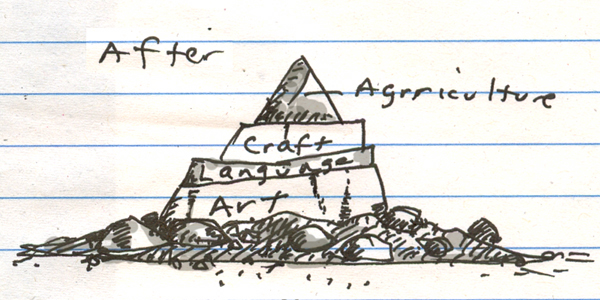
The survival of the native languages is only an apparent exception to the rule of symbolic extinction.— George Kubler
A poncho from Peru, circa 900 AD
George Kubler's
Colonial Extinction of the Motifs of Pre-Columbian Art (1961)
theorizes the relationship between an overwhelmingly dominant culture as it extinguishes a weaker one. Perhaps his model can be used to understand the current situation of refugees and explain the real challenges faced by those who attempt to build, preserve and promote their communities while redirecting the power of those in the dominant culture towards reciprocal acculturation (sharing, mutual respect) and away from benign neglect, coercion, threats or force.
Kubler catalogs the responses of the weak as they salvage whatever they can of their past life while living under the constant pressure and demands of a powerful new culture. Of the five he lists, four should be avoided because they lead to the elimination of the weak by the strong.
“Convergence”, or the convergence of interests between the dominant and weak, is a matter of appearances like the trick of perspective that implies railroad tracks meet in the distance. Those in power are never threatened with face to face encounters with the weak. For the many Montagnard congregations here in the Piedmont, Christianity is an example of convergence, the appearance of shared values between themselves and mainstream churches. Both sides have reasons to maintain the illusion of a common mission but American faith-based organizations and mainstream churches have an especially big stake. They have been in the forefront of refugee resettlement in Greensboro and have recently been subjected to
sharp criticism which eventually resulted in one agency quitting the region. A real encounter with all cultural obstacles removed and the playing field leveled would assign blame and reveal the current system for what it is — a mess. So what do Montagnard churches get out this? Surprisingly, they get the freedom to be left alone to tend to their people as they see fit.
Kubler uses the term “explants” to mean the brief continuation of traditional habits or activities (also non-threatening) that eventually whither under the dominant culture. Some refugees believe in the power of amulets and one was amazed that their power could work here in America, protecting its wearer from a hail of bullets during a forced house entry. But it’s unlikely the children of this refugee will share her belief. The remarkable stories of many Montagnards,
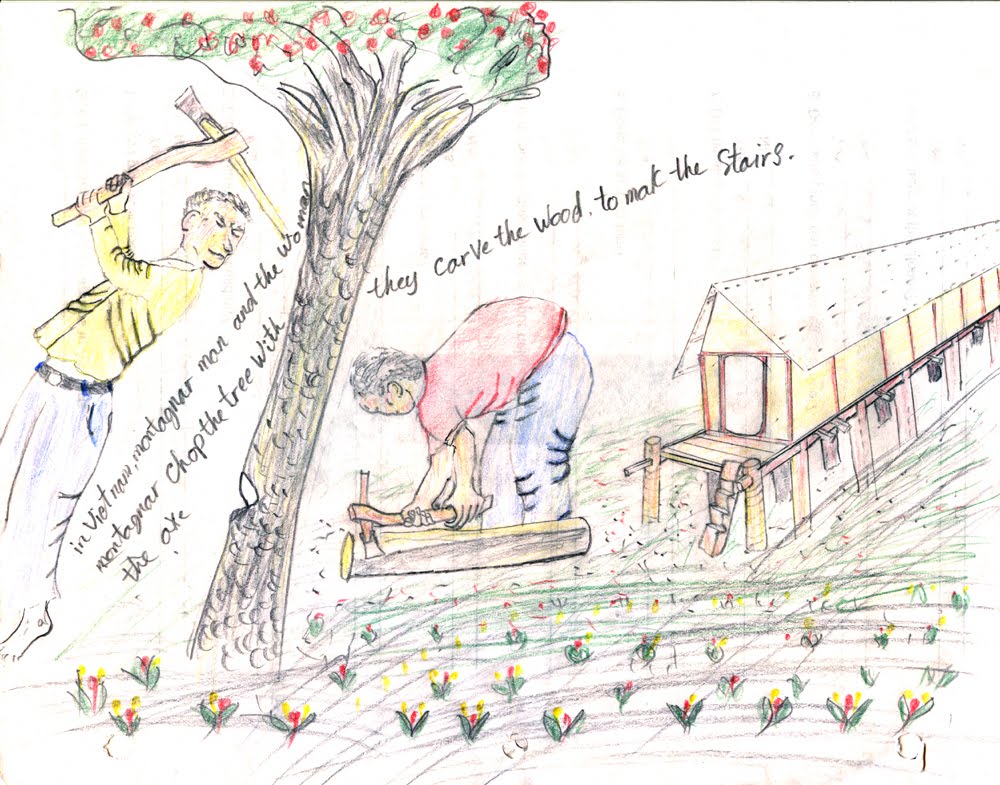
especially women, are probably destined to go unnoticed and unrecorded however rich their oral culture may be, because the transition from a preliterate society to a collection of detribalized literates (to borrow from McCluhan) is consistent with funded refugee resettlement practices. What will live on? Probably the selective stories of combat and political struggle as described by Montagnard men who fought alongside Americans and recorded by Special Forces vets who have an interest in the shaping and retelling of these tales. (Notice that the illustration at the end of this entry depicting a Montagnard crossbow breaks with this narrative, suggesting some Montagnards were
attacking American forces.)
“Transplants” represent isolated pieces from the weaker culture transplanted into the “soil” of the dominant culture. In the Montagnard community, this literally means growing
kabocha squash, bitter melon or water spinach in Greensboro backyards or in buckets and boxes arranged to catch sunlight in the city's rundown apartment complexes. None of these vegetables are in the normal American diet and refugees’ little garden plots are rarely considered a threat to American norms. If local mainstream residents ever discover the healthy benefits of eating a more diversified, locally grown supply of food (that is, if it ever becomes “hip” in Greensboro to eat Thai eggplant, squash tendrils, etc.) then transplanted habits might “take” more firmly in Piedmont dirt. Today the reality is different. Chronic diseases caused by poor diet and lack of exercise plague the Montagnard population, whose health stats more and more resemble mainstream Americans’.
“Fragments” are distantly remembered forms and ideas that might be traced and retraced by survivors who have forgotten their symbolic meaning. Music and the arts can fall into this category. Refugee kids might mouth the words but not understand the context of songs. Weavers might create patterns but forget their origins in a world that has vanished. By Kubler's definition Art, which we tend to associate with reinvention and renewal, instead becomes the signpost of a downward spiral, pointing to the death of a culture. We're reminded of a textile expert who told us traditional weavers in Southeast Asia are dying out as traditional forms and symbols become industrialized, commercialized and sold us tourist items. Here in the Piedmont we see mostly old women,
master weavers, with no pupils to inspire.
Dock Rmah and Y Suk Bukrong are both skilled traditional musicians who are uncertain who will follow them. Maybe young artists like the rapper
Mondega can spark a turnaround by
initiating a dialog between generations.
Only the fifth response Kubler cites, “juxaposition”, offers the slim possibility of an intact survival of old ways. Reciprocal acculturation “of which there are very few examples in the history of Christianity” means a policy of listening to the needs and interests of refugee communities and working with them to create joint solutions, even while power disparities remain starkly drawn. A recent suggestion to locate a refugee welcome center at a popular international shopping complex was an example of accommodation in the spirit of juxtaposition. Its quick rejection by refugee resettlement specialists suggests that power, not collaboration or cooperation, continue to underly and guide most decision making about refugees in the Piedmont.
LEARNING FROM KUBLER: WHENEVER REFUGEES SUCCEED IN
ALTERING AMERICAN BEHAVIOR, THEY HAVE THE CHANCE TO
PRESERVE IMPORTANT PARTS OF THEIR CULTURE.
Agriculturist to agriculturist: An American farmer
and ESOL teacher works alongside his students at
a community garden.
Refugee farmers learn about “lasagna gardening”...
... And quickly adopt their skills.
This team started a new community garden in a
single morning.
International sustainability: Refugee farmers
attended a Carolina Farm Stewardship Association
conference on best practices and organic techniques.
Woman to woman: A university researcher is
shown various food products by refugee women
at their local ethnic store.
Artist to artist: Montagnard artist shares his portfolio
on an iPod with a Canadian performance artist.
Artist to artists: A traditional Montagnard musician
demonstrates before American student artists and musicians.
Youth to youth: University art students Skype with
rapper Mondega (right), voted MTV Iggy Artist of
the Week in December 2010.
An Amerasian learns how to tell her life story
through digital media.
While video documenting a traditional recipe to
students, a Montagnard woman connects her farm,
her escape into the jungle, her relationship to
her mother and the importance of food in her life.
Electronic media used by refugees from oral societies to
record their trip to UNCSA. McCluhan would approve.
Craftswomen meet: Two master weavers meet with
an Australian expert and North Carolina fabric artists.
A Montagnard mom shares her spinning technique.
Communicating by doing. A master weaver from
Vietnam with only rudimentary English skill
shows women weavers from Bhutan how to transfer
the warp to the loom. A shared passion to continue
their craft brought these women together.
Public health grad students interview a community health worker.
 Lay health workers help a university
researcher to conduct interviews.
A lay health worker who never received formal
schooling in her country discusses emergency
planning with her community.
Multilingualism versus ESOL. The celebration of
the sounds of languages from oral societies. Many
Montagnards speak 3, 4, 5 or 6 languages.
Translation of Census 2010 paid by a grant from the
Southern Coalition for Social Justice.
The opening of the largest Montagnard-owned
store attracted hundreds of neighbors including
African-Americans, Latinos, and Asians to share
food and music.
Kitchen to kitchen: A collaboration between refugee
and American chefs to produce a new dish reflecting
each chef's food traditions.
Lay health workers help a university
researcher to conduct interviews.
A lay health worker who never received formal
schooling in her country discusses emergency
planning with her community.
Multilingualism versus ESOL. The celebration of
the sounds of languages from oral societies. Many
Montagnards speak 3, 4, 5 or 6 languages.
Translation of Census 2010 paid by a grant from the
Southern Coalition for Social Justice.
The opening of the largest Montagnard-owned
store attracted hundreds of neighbors including
African-Americans, Latinos, and Asians to share
food and music.
Kitchen to kitchen: A collaboration between refugee
and American chefs to produce a new dish reflecting
each chef's food traditions.
An American chef, immigrant chef, and Bhutanese
refugee mom create a collaborative dish.
Refugee and American chefs share the stage.
 Iraq meets America: A group effort
Food as a medium for communication.
The interviewer is a blogger and media
specialist. The respondent is a refugee
who rarely has the opportunity to share
her culture with mainstream Americans.
Iraq meets America: A group effort
Food as a medium for communication.
The interviewer is a blogger and media
specialist. The respondent is a refugee
who rarely has the opportunity to share
her culture with mainstream Americans.
Public presentation of collaborative dishes in Winston-Salem.
Then they will be Americans. Then they will be just like us. By current standards, this is success.
Culture raffle today. “Apparently there is nothing that cannot happen.” — Mark Twain
The antidote to Kubler’s devastating assessment of Spanish power in the New World is the plea by anthropologist
Wade Davis to regard traditional people not as failed attempts to be like us, but rather to see them as equals faced with the same profound questions about what it means to be human. McCluhan specifically identifies artists as specialists able to deal with and respond to collapse, change, and revolutionary technologies. And it is they who most easily connect to the refugee experience because they are attuned to the fundamental cultural struggle they're engaged in. For these reasons, we have supported direct exchanges between refugee and mainstream creatives and artists. To reconsider the presence of thousands of refugees who now call Greensboro or Guilford County their home in this light would be to reconsider the policies and practices that treat them as social problems. It would make us question the agencies that carry out these policies under the banner of faith (or limited budgets) and ask if there are not better models for community building and dialog?

Southeast Asian Bob becomes American Bob, courtesy of Face of the Future