Showing posts with label refugee mothers. Show all posts

Getting Moms into Doctors' Offices (1)

FOUR RECENT CASES SHOW WHY INDIGENT HEALTH CARE IS HARD TO OBTAIN FOR MONTAGNARD REFUGEES AND HOW COMMUNITY HEALTH WORKERS ARE AN AFFORDABLE SOLUTION FOR TIME-INTENSIVE OUTREACH AND FOLLOW UP
SEE PART 2


WORKING WITH MONTAGNARD LAY community health workers, we identified 13 steps to get refugee moms indigent healthcare (the "Orange Card" issued by the Guilford Community Care Network) so they can see a doctor. In Montagnard families, working dads are sometimes covered by employers and children qualify for Medicaid, leaving moms the most vulnerable member. Without health coverage they suffer from illnesses and chronic problems. 

Every step presents opportunities for failure. Our lay health workers operate within the cultural constraints of their community. We don't have a steady framework of grants or funding sources to adequately pay them but their liaison skills are critical; they speak all the languages needed to contact families. They are familiar with the qualifying process and can explain it. But the most needy Montagnard families are often preliterate. Financial papers, receipts and junk mail are mixed together. Records are lost or missing.

Recently, we worked with four Montagnard families to get Orange Cards. Our lay health workers — mothers themselves — identified neighbors who hadn't been to a doctor in years. One is in regular pain. Each speaks a different language. Three are preliterate; they do not read their native language. Their English skill is poor. All receive food stamps. If they can find childcare or bus fare, they attend ESOL classes. But in general, the services they receive from local agencies are disconnected and sporadic. It is only through contacts with our lay health workers that we know their plight. We spent the week prepping the women to get their papers together. One got the card, one might get it next week, and two are in limbo.
The first mom is middle aged. Her husband worked but made poverty level (minimum) wages, easily qualifying her for the Orange Card. At the qualifying interview she failed to bring bank statements even though we explained their necessity. The family made it a regular habit to throw them away and because only her husband's name appeared on the statement, we couldn't go to the bank and get copies.

The second mom came from a very troubled home. She looks like she's sixty but her ID states she's in her early 50s. She has several grown kids back in Vietnam and lots of grandchildren there, too. Several months ago we tried to get her an Orange Card and failed. Then we tried again at a health fair. Her paper work was good and her son accompanied her to verify his wages. But she never got her card. By our third try her family's circumstances had changed.  Her husband was out of jail but unemployed. The son was no longer being paid under the table by his employer. He had check stubs — proof of income — but now he was working out of state. He'd be back in another week, maybe. In the meantime, our second mom suffers from chronic pain.

The third mom is from a young family. The husband works sporadically and is now out of town. We'd like to get him to verify his wages (again, they're poverty level). The husband doesn't have a great reputation but we're trying to help his wife, not him. If we can get records of his recent wages she can get an Orange Card. We have asked a community leader for additional assistance. 

The fourth mom is middle aged. Her husband is elderly but works part time. She is well liked by people in her community and has rudimentary writing skills. She has all her paper work in order and receives her Orange Card. Our lay health workers will follow up and schedule her first doctor's appointment at Healthserve with a call next week.

Montagnard Food at UNCSA

SPRING ROLL RECIPE: How food leads to life stories
PART OF OUR WORK WITH UNCSA DMA-DEGA PROJECT


As part of our collaboration with Bob King and his UNCSA students, our two lay health workers demonstrated how to make spring rolls — a decidedly Vietnamese dish —which lead to the telling of a story about living in the jungle to escape war, the scarcity of food then, the importance of food today and her mother's influence. Filmed in May, 2011in Winston-Salem, NC.

Postscript: The storyteller's mother died in Vietnam in June 2011, a month after this video was made. She was probably between 90 and 98 — maybe not quite 100 years old as told in the story — but  clearly the eldest in her village.

Transcription (with interpretation to make the speaker's answers clearer):

Question: How old were you when you went to the jungle?

I was twelve... No eleven years old (in 1979).

I had been in the jungle for twelve years. Then I came to the USA in 1992. Now I'm 43. That was long ago!

I gave birth to two babies — two kids — in the jungle. I gave birth to them myself, no doctor, no people to take care of them. I took care of them myself. I cut the umbilical cord myself, I did it by myself. I took care of two kids in the jungle.

Then one girl was born over here in the USA. I had a doctor over here. Then my family felt hurt. They cried for me. Because why? Because they didn't know where I was. Because some people didn't know. Why did you stay there like that (in the jungle out of contact)?

Then my dad died. I don't know. My mom, my mom's 100 right now. Yeah, my mom's 100 now. She's old, old, very old.

I take care of her right now. I say to her, "I still borrow your money." I tell my mom and dad — my dad is gone now — but I tell my mom, "I still borrow from you."

"Why do you say 'I borrow?'"

Because she took care of me!

Then when I get money— even just a little bit — I send it to her. Yes.

Then I explain to her, "I borrowed your money". But I didn't borrow her money really, but she fed me and took care of me.

So I pay her back.

"When I send this money back to you, I repay you." I say it like that.

She cries. She says I'm a smart girl — but I'm not smart because I didn't want to tell my mom and my dad and my family I didn't want to go to school because I was a girl and it would be better if I help my dad. Yes, I helped my dad.

I helped my mom by farming and helping to feed everybody in the house. When I had to leave there was nothing I could do to help them.

And I went in the jungle so I could not go to school. So now, I don't know how to read and write. But I speak English a little — not a lot — just a little. I speak Jarai, Bunong, Rhade, Koho, Vietnamese and English.

I speak a lot!

Question: Why did you have to go to the jungle?

Why? Because — I don't know. I was too young to understand.

(At another interview Kwol explained that the Viet Cong came to her village a few days earlier and forced her to stand in a latrine up to her neck for a full day, pressing her to give names of dissidents in the Montagnard community.)

I went to work. I remembered helping my dad and my mom and my sister, my ex's sister, my family. I have ten family members. I'm the baby. I'm the youngest so I helped my dad with his farm work.

A man already hiding in the jungle said the Viet Cong are going to take me from the farm. At our farm we grew rice, coffee, and someone was coming to get me. I don't know.

Question: You don't know?

I didn't know anything. I cried and cried. I cried everyday. I stayed in the jungle and the next day I woke up and I wanted to see my mom. Where's my mom? Someone said, you stay here without her. I had my brothers with me, two brothers, but both died. My brother in law died. My sister's son, he died. Then there was only me. Five of us fled to the jungle. But all but me died.

Question: They died of illness?

They died in the jungle. By the Viet Cong they were killed. The Viet Cong killed them.

Then I went back to see my mom because it was a such a long time — in 2003. My mom didn't recognize me.

She said, "You're not my daughter." Yes, it's true. She said, "You're not my daughter."

I said, "No, it's me, Kwol."

"No, you died. Kwol died long ago," she said it like that.

"No, it's me", I said it like that. Then I took her and cried and cried.

I hugged her and she said, "You smell different." Because here in the US it's different than in Vietnam, where there's no food or anything. So that's why she said I smelled different.

But I don't know, I still remember when I stayed in the jungle and I ate food — I ate anything. I still remember this.

Sometimes I when I tell my story to my mom, my mom says, "Yeah, if you don't remember this you'll forget it."

She says, "You'll forget it." 

"You stay in America. You've made a good life."

She says I've got a good life here and freedom. Freedom and I've got food to eat.

"You feed your kids."

My mom tells me that.

Orange Card For Refugee Moms

Refugee and Diversity > Health > Orange Card for Refugee Moms
The Orange Card is a pre-approved, sliding scale health care program for those without coverage.
PDF color download
Awareness
Costs are low and almost all Montagnard families qualify because of their low income and numbers of people in the household. But while some families might have good insurance through the father's employer that includes the kids, often the mother is left without coverage. This design points out the economic choices a family makes and informs members that mom's visits to the doctor are affordable compared to other costs, especially those detrimental to good health.

Forgetting or not understanding which documents to bring
Successful enrollment requires several documents and proof of need, but too many fail to bring the correct papers. The handout shown below is designed for easy reading and as a visual reminder for those who cannot read or read with difficulty.

Driving home the message
We plan to have the lay health team use the handout to explain to moms and family members so when they come to sign-up sessions, they'll be quickly enrolled. We can introduce this at the end of food insecurity interviews and use it in ESOL classes. Through this coordinated approach, we hope to improve enrollment numbers and get eligible community members covered.

PDF color download
PDF bw download


Collaborative Process: Refugee Community Health Team

(Refugee and Diversity Projects) >Health > (Overview: Refugee Community Health Team) > Collaborative Process: Refugee Community Health Team 


A COLLABORATIVE PROCESS BUILT ON MUTUAL INTERESTS

December 2010. Khin H and Kwol Ksa wear their UNCG badges identifying them as community health workers and carry their university bags for the first time.


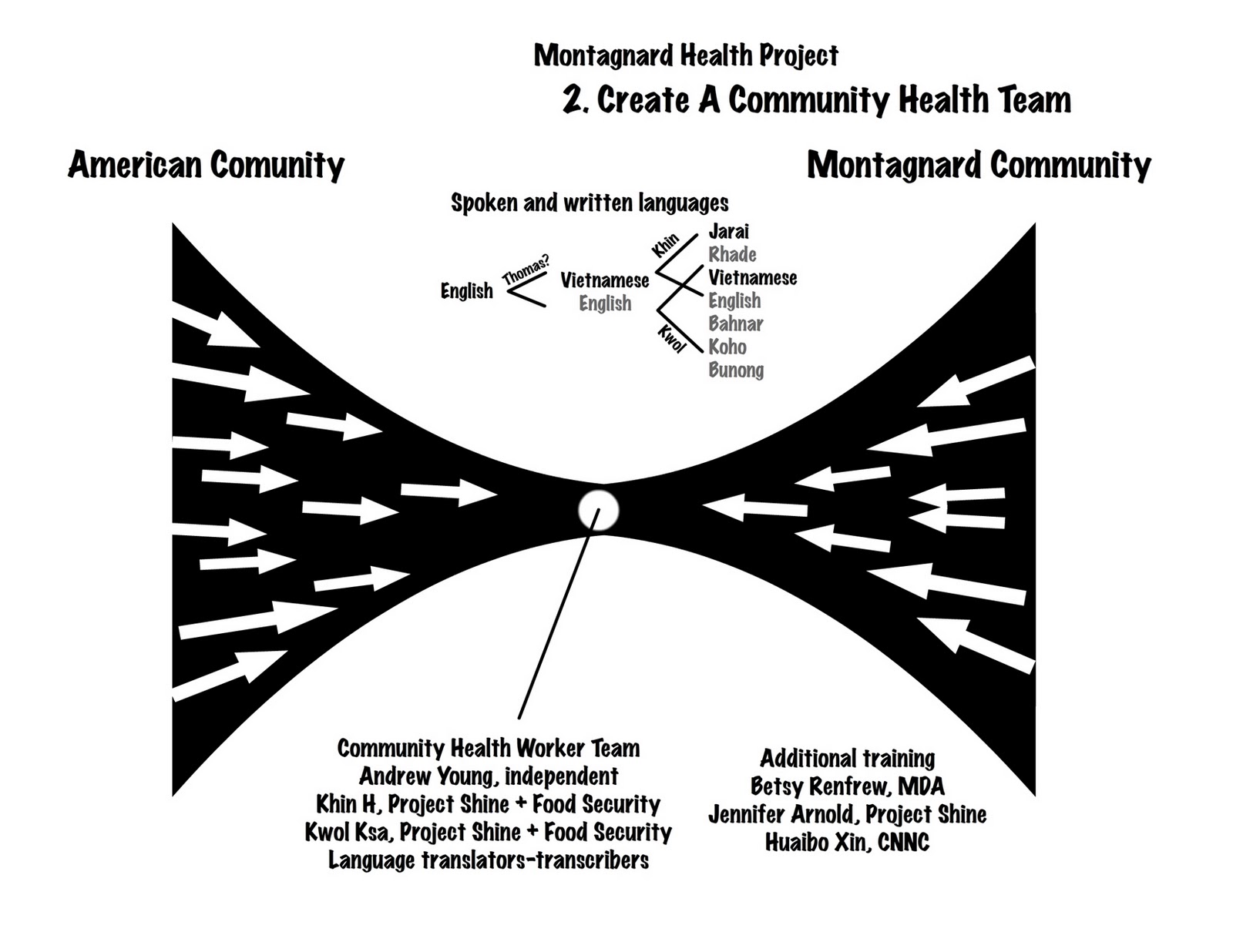
These graphics were used to explain how multiple resources and interests could come together to make permanent inroads into the Montagnard community for the purposes of data collection, information exchange, and improved community health. In November 2010, I got the go-ahead from UNCG's Dr. Jigna Dharod and Project Shine's Mandy Benson to proceed with training.

1. Data Gathering Problem. For the American side to collect data required it to overcome the longstanding bottleneck created by difficult language and cultural problems.

2. Create a Community Health Team. I proposed that a health team created specifically to address language problems could help increase the flow of data from the Montagnard to the American community. Only through a team approach could we cover all the languages and cultural nuances represented in the Montagnard community. I further proposed that women with the time and motivation could be trained to conduct health interviews. The costs of their training would be offset by the value of the data they could gather and the permanent inroads they could create.

3. Long Term Capacity Building. Over time, as the team's education and experience grew, it would open the bottleneck and facilitate more exchanges.

4. Stakeholders in the Community Health Team. For the first time, we could figure out how overlapping interests could help fund and get started the organization and training of a health team.


5. Time Line. The health team will aid in the completion of specific data-gathering surveys as well as help with general health information and health literacy training in the community.