Showing posts with label concept map. Show all posts

Getting Moms into Doctors' Offices (1)

FOUR RECENT CASES SHOW WHY INDIGENT HEALTH CARE IS HARD TO OBTAIN FOR MONTAGNARD REFUGEES AND HOW COMMUNITY HEALTH WORKERS ARE AN AFFORDABLE SOLUTION FOR TIME-INTENSIVE OUTREACH AND FOLLOW UP
SEE PART 2


WORKING WITH MONTAGNARD LAY community health workers, we identified 13 steps to get refugee moms indigent healthcare (the "Orange Card" issued by the Guilford Community Care Network) so they can see a doctor. In Montagnard families, working dads are sometimes covered by employers and children qualify for Medicaid, leaving moms the most vulnerable member. Without health coverage they suffer from illnesses and chronic problems. 

Every step presents opportunities for failure. Our lay health workers operate within the cultural constraints of their community. We don't have a steady framework of grants or funding sources to adequately pay them but their liaison skills are critical; they speak all the languages needed to contact families. They are familiar with the qualifying process and can explain it. But the most needy Montagnard families are often preliterate. Financial papers, receipts and junk mail are mixed together. Records are lost or missing.

Recently, we worked with four Montagnard families to get Orange Cards. Our lay health workers — mothers themselves — identified neighbors who hadn't been to a doctor in years. One is in regular pain. Each speaks a different language. Three are preliterate; they do not read their native language. Their English skill is poor. All receive food stamps. If they can find childcare or bus fare, they attend ESOL classes. But in general, the services they receive from local agencies are disconnected and sporadic. It is only through contacts with our lay health workers that we know their plight. We spent the week prepping the women to get their papers together. One got the card, one might get it next week, and two are in limbo.
The first mom is middle aged. Her husband worked but made poverty level (minimum) wages, easily qualifying her for the Orange Card. At the qualifying interview she failed to bring bank statements even though we explained their necessity. The family made it a regular habit to throw them away and because only her husband's name appeared on the statement, we couldn't go to the bank and get copies.

The second mom came from a very troubled home. She looks like she's sixty but her ID states she's in her early 50s. She has several grown kids back in Vietnam and lots of grandchildren there, too. Several months ago we tried to get her an Orange Card and failed. Then we tried again at a health fair. Her paper work was good and her son accompanied her to verify his wages. But she never got her card. By our third try her family's circumstances had changed.  Her husband was out of jail but unemployed. The son was no longer being paid under the table by his employer. He had check stubs — proof of income — but now he was working out of state. He'd be back in another week, maybe. In the meantime, our second mom suffers from chronic pain.

The third mom is from a young family. The husband works sporadically and is now out of town. We'd like to get him to verify his wages (again, they're poverty level). The husband doesn't have a great reputation but we're trying to help his wife, not him. If we can get records of his recent wages she can get an Orange Card. We have asked a community leader for additional assistance. 

The fourth mom is middle aged. Her husband is elderly but works part time. She is well liked by people in her community and has rudimentary writing skills. She has all her paper work in order and receives her Orange Card. Our lay health workers will follow up and schedule her first doctor's appointment at Healthserve with a call next week.

Montagnard Refugee Concept Map

Refugee and Diversity > Make the Pie Bigger  > Montagnard Refugee Concept Map
2011. VISUALIZATION OF A BROKEN SYSTEM
However you arrange the pieces, the whole remains a mess

     VERSION 1.                                         click to enlarge

THIS IS A CONCEPT MAP I created based on a thumbnail sketch we used as part of our discussion about how our group can help the Montagnard community. In this Version 1, I stopped connecting dots among stakeholders after the clutter began piling up and it was no longer easy to track relationships or responsibilities. The resulting visual mess seems to reflect the real life confusion that's derailed almost every refugee initiative of the past couple of years: decentralized network, lack of leadership, difficulty communicating, difficulty understanding boundaries. What has succeeded? Small groups that can work without the network: NAI, Elon Law, Triad Nepalese Community Center, among others.

Above all, it is difficult to explain this tortuous landscape to outside funders, experts, or potential partners who could help. I will play around with the graphic order and try to make a prettier picture in Version 2.

Some preliminary observations: There are many stakeholders (I left off trying to list individual American churches), it is hard to understand the City of Greensboro’s involvement in the Montagnard community and there are no businesses involved except Moses Cone Hospital System. Oh! There's no technology presence. It seems like we've really ceded community building to churches and nonprofit refugee agencies.

I wonder how the Montagnard community would map their encounters with the American refugee system? 

NOTHING TO BRAG ABOUT
A second try at visualizing the refugee system in Greensboro
    VERSION 2.                                     click to enlarge


THIS IS THE SECOND VERSION, “prettier” than the first but no less confusing. I've put Montagnard Dega Association (MDA) in the middle and sought to trace its relations to many of the important refugee stakeholders. Heavily outlined names represent independent stakeholders. Heavy connecting lines from MDA delineate strong relations, dotted lines represent unknown or tentative connections. Admittedly, a lot of this is guesswork, but only because the entire refugee system lacks transparency. 

A NEW VISION, A NEW SYSTEM
To read a one page pitch on why we concentrate on the Montagnard population, see BRIEFS

Jim Keith and I have been conversing about how we can maximize outcomes from limited resources, regarding the Montagnards and other refugee groups.

Here are our working premises:

1. We have focused on the Montagnard community because it represents one of the oldest refugee groups in Greensboro and most likely, the largest. Further, although they have been with us a long time, we have not yet envisioned and created a good system for responding to their needs and interests. We recognize that the experiences of refugees are an integral part of our community. As such, their problems are our problems.

2. We need to work harder to serve the Montagnard group well AND in doing so, create a vision/system that can serve as a model for OTHER refugee groups coming here.

3. As everyone acknowledges, the current system is unsustainable. We believe refugees are not the problem but an important part of Greensboro's future. As such, they must be engaged now in the important business of community building.

4. So, as we acknowledge, learn from, and seek to build on past efforts, we think the time is ripe to CONSOLIDATE and LEVERAGE our group's achievements, to clearly explain a new vision, and build a sustainable model for the future.


Diet, Food and Health Concept Map (Updated)

(Refugee and Diversity Projects) > Health > Diet, Food and Health Concept Map

A MONTAGNARD-CENTRIC APPROACH TO DIET AND HEALTH

Newer version. Click to enlarge.


Old version. Click to enlarge.
__________________________________________________________________

BMI chart. Click to enlarge
__________________________________________________________________

Background
I trained a Montagnard women’s lay community health team to assist UNCG researchers contact families, schedule interviews and interpret. A survey about food insecurity required the team to understand the relationship of behaviors and lifestyle choices to health problems in their community.
__________________________________________________________________

THIS MAP CONTAINS TERMS I used and developed to explain the relationship of key concepts contained in a Food Insecurity survey. The map could have started at any point, but I started with the question the Montagnard women health team asked, “Am I fat?”, when they asked me how they could lose weight.

What worked? they asked. Diet tea? Brown rice? Weight pills?

Why did they wish to lose weight? I asked.

How do you know you’re fat to begin with? led to the concept of BMI, how to read a BMI chart and how to use a scale and how to measure yourself. Then these exercises were carried out in Betsy's MDA ESOL class the next day with community members and the women working side by side. The next set of questions from the women came the day after, asking if many people they tested seemed to have BMI numbers then why was there so much illness in the community, like high blood pressure, stroke, diabetes, etc? At this point, they had arrived at the same place as Jigna Dharod, the researcher who assigned them to conduct the survey.

Now they could understand why the Food Insecurity survey asked community members about what they ate and when, where they shopped, and what did they eat in Vietnam. Fatness leads to all kinds of major diseases in Americans, but for the Montagnards it appears heavy salt is the culprit, along with far less physical exertion and exercise. For weeks we studied these questions, their meaning and how they related to their experience in Vietnam villages, in the jungle and here in the US. By looking at it from their viewpoint and walking their path towards understanding, I believe the women have a far stronger idea of the influence of diet on health than they would have had we kept to American health literature, explanations, and cultural ideas.
__________________________________________________________________

Related

Collaborative Process: Refugee Community Health Team

(Refugee and Diversity Projects) >Health > (Overview: Refugee Community Health Team) > Collaborative Process: Refugee Community Health Team 


A COLLABORATIVE PROCESS BUILT ON MUTUAL INTERESTS

December 2010. Khin H and Kwol Ksa wear their UNCG badges identifying them as community health workers and carry their university bags for the first time.


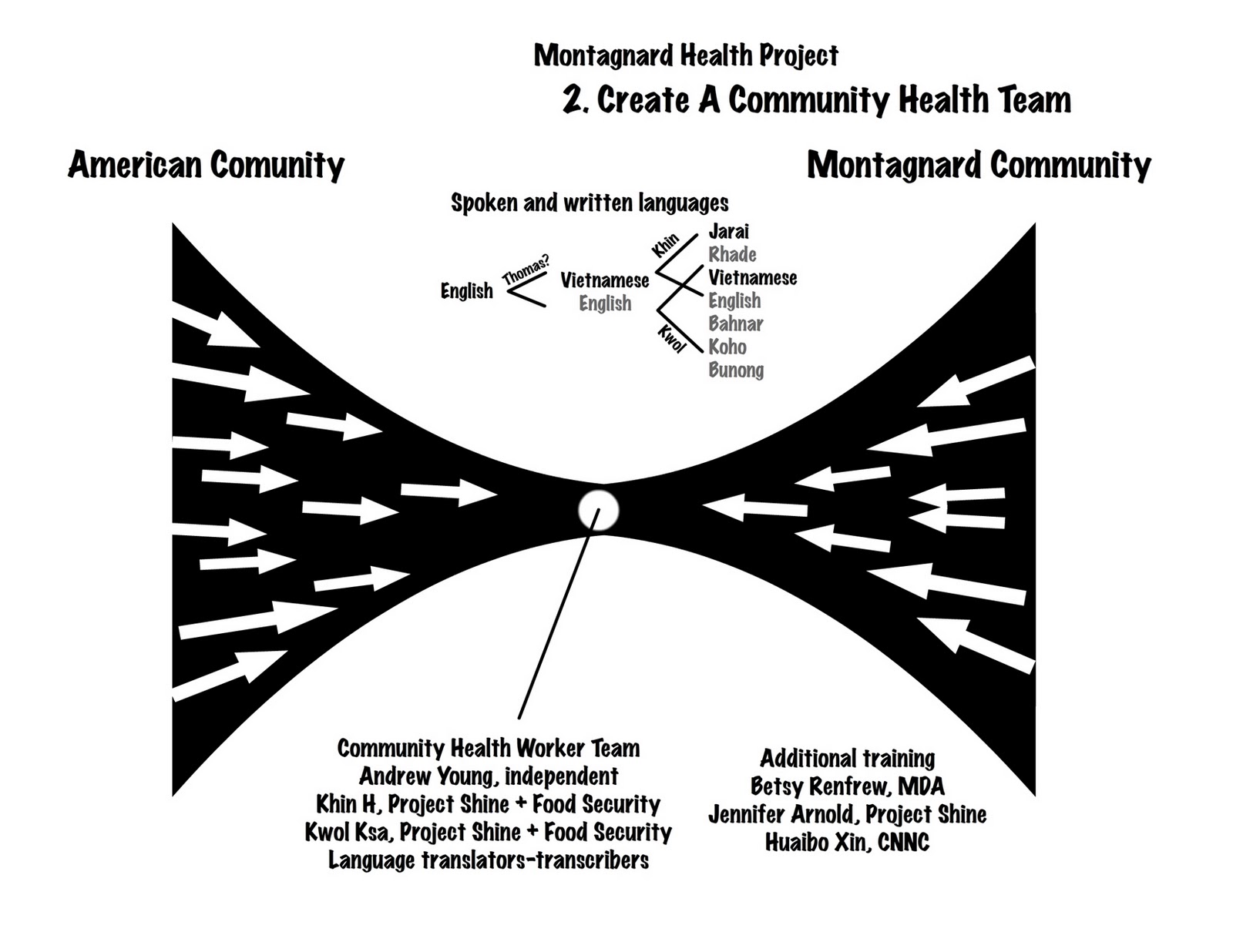
These graphics were used to explain how multiple resources and interests could come together to make permanent inroads into the Montagnard community for the purposes of data collection, information exchange, and improved community health. In November 2010, I got the go-ahead from UNCG's Dr. Jigna Dharod and Project Shine's Mandy Benson to proceed with training.

1. Data Gathering Problem. For the American side to collect data required it to overcome the longstanding bottleneck created by difficult language and cultural problems.

2. Create a Community Health Team. I proposed that a health team created specifically to address language problems could help increase the flow of data from the Montagnard to the American community. Only through a team approach could we cover all the languages and cultural nuances represented in the Montagnard community. I further proposed that women with the time and motivation could be trained to conduct health interviews. The costs of their training would be offset by the value of the data they could gather and the permanent inroads they could create.

3. Long Term Capacity Building. Over time, as the team's education and experience grew, it would open the bottleneck and facilitate more exchanges.

4. Stakeholders in the Community Health Team. For the first time, we could figure out how overlapping interests could help fund and get started the organization and training of a health team.


5. Time Line. The health team will aid in the completion of specific data-gathering surveys as well as help with general health information and health literacy training in the community.